Basecamp → The Principles → TRANSFORMATIVE Experiences
“And if Eeyore’s back snapped suddenly, then we could all laugh. Ha ha! Amusing in a quiet way,” said Eeyore, “but not really helpful.”
“Well,” said Piglet meekly, “I thought —”
“Would it break your back, Eeyore?” asked Pooh, very much surprised.
“That’s what would be so interesting, Pooh. Not being quite sure till afterwards.”
Pooh said “Oh!” and they all began to think again.
~ A. A. Milne, Winnie the Pooh
Transformative Experiences are like Eeyore’s hypothetical back-snap in Winnie the Pooh — we can’t be sure what will happen until after it occurs. These experiences change us in ways we can’t predict, teaching us things we can only learn by living through them.
Just as Pooh and friends ponder the uncertain outcome of Eeyore’s back snapping, we face uncertainty when entering transformative situations. These might include becoming a parent, choosing a career, or facing a personal crisis. Yet, transformative experiences can occur in any situation we perceive as meaningful when filtered through our Ordinating Principles, not just in life’s most significant decisions.
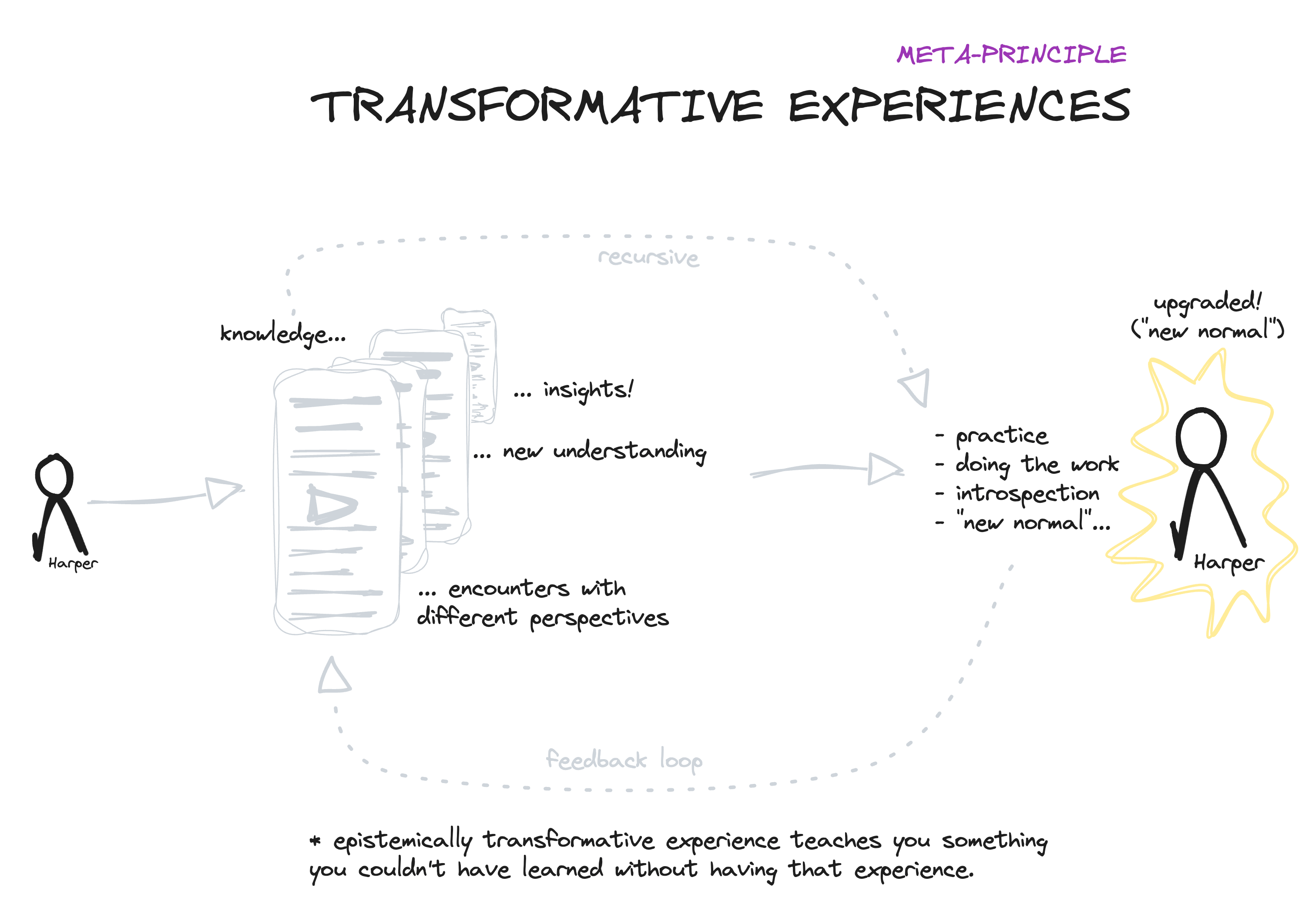
The process of transformation works like this:
- We gain new knowledge and experience insights…
- We encounter different perspectives (which can trigger an encounter with paradox and disorientation)…
- We filter these through our Ordinating Principles…
- We practice (learn through doing)…
- We reflect on our changes (and update our internal models)…
This cycle repeats, creating a “new normal” — an upgraded version of ourselves. Each round builds on the last, deepening our transformation.
When we use these ideas within our Tiny Digital Worlds, we create powerful learning spaces. These worlds help people learn and see things in new ways, offering experiences that books or videos can’t match.
§
In her book Transformative Experience, L.A. Paul introduces the concept of transformative experiences. This concept helps us understand the potential impact of digital worlds intentionally designed to incorporate principles and concepts that facilitate transformative experiences.
Paul describes a “transformative experience” as both epistemically and personally transformative. An epistemically transformative experience teaches you something you couldn’t have learned without having that experience. It’s something you can’t know about merely by hearing or reading about it — you have to actually experience it yourself to understand it fully.
Transformative experiences are profound moments that reshape our core preferences and understanding of ourselves and the world.
These experiences often surprise us. They can profoundly impact our beliefs and worldviews. They open doors to new perspectives.
As digital world builders, we have a clear goal. We create environments that afford powerful experiences. These spaces provide content and interactions that challenge how people think, encourage reflection, and ultimately empower individuals like Harper to embark on transformative journeys of personal growth.
Digital world-building offers a fresh alternative to traditional digital marketing funnels. While funnels guide users along a fixed, often forced path, digital worlds create open environments where users can explore more freely.
This openness allows for unexpected interactions and outcomes to emerge. As a result, people like Harper experience a more authentic, less contrived journey that aligns with their interests and motivations.
This approach enhances the experience and unlocks the potential for genuine engagement and discovery that more rigid marketing funnels can’t match.
It’s worth noting that marketing funnels haven’t disappeared entirely. Instead, they’ve evolved to become less explicit and more implicit within these digital worlds, seamlessly blending with Harper’s journey.
It’s the difference between being told what to think or feel and discovering it for yourself through an immersive, interactive experience.
At the heart of these transformative experiences lies the digital world’s ‘Heartbeat‘ — a resonance that reflects the creator’s values, beliefs, and aspirations. It’s the essence of the world-builder, infused into the milieu of the digital world.
This Heartbeat sets the stage for transformation, creating a space where Harper feels not just engaged but also deeply understood, valued, and empowered. It orients them and guides their journey.
The Heartbeat’s consistent, authentic presence builds trust and credibility, inviting Harper to let down their guard and open themselves to new possibilities.
It creates a sense of connection and identification, fostering a deep, personal investment in the world and its ethos. This sense of connection and identification makes our audience feel engaged and connected.
Such experiences can be personally transformative, profoundly altering one’s beliefs, desires, and values. By engaging with a digital world that embodies a particular ethos, individuals may find themselves changed in ways they couldn’t have expected.
This transformative potential is inherent in the system’s emergent nature, as the complex interactions between the user and the environment give rise to unique, unpredictable outcomes.
As Harper engages with the digital world’s content and experiences, the Heartbeat acts as a catalyst for transformation. It challenges Harper’s assumptions and beliefs, presenting new perspectives and ideas that resonate with their inner truth.
It inspires them to question, to explore, and embrace change.
By following these principles, digital worlds offer more than just sharing information or promoting products; they become a platform for personal growth and transformation.
By creating spaces that allow for transformative experiences, we enable a deeper, more meaningful form of engagement. This approach goes beyond persuasion, tapping into our fundamental capacity for change and discovery.
This potential for personal growth and transformation should inspire and motivate us as digital world builders.
Digital worlds have unique power. They create conditions for transformative experiences, which emerge naturally as Harper interacts with the environment (and scales infinitely). The world’s design and underlying values shape these interactions.
In this space, simple elements combine to create something more significant as complexity emerges naturally. We see design and engineering work together, revealing the true potential of digital world-building. It’s more than just the sum of its parts. It feels alive.