4 min read
“The modern makers’ machine does not want you to create heavy things. It runs on the internet – powered by social media, fueled by mass appeal, and addicted to speed. It thrives on spikes, scrolls, and screenshots. It resists weight and avoids friction. It does not care for patience, deliberation, or anything but production.” — Anu Atluru (Make Something Heavy)
Most creators don’t have a content problem. (Especially with AI.)
They have a structure problem. (AI can’t fix this part.)
It shows up like this:
You publish something.
It gets a little attention.
And then…
… it starts to fade.
A day later, it’s essentially gone.
A week later, it may as well not exist.
So you create something new.
And the cycle repeats.
Over time, it starts to feel like you’re building nothing at all.
Just producing.
Nothing accumulates.
Part of the issue is how most content is created.
It’s siloed.
Each piece stands alone.
Written in response to whatever feels relevant in the moment.
Disconnected from what came before.
Unrelated to what comes next.
A stream of isolated thoughts.
Even when the work is good…
… it doesn’t accumulate into anything larger.
But there’s a deeper layer most people never see.
It’s not just what you create.
It’s where that creation lives.
Most platforms are designed for flow, not structure.
They reward what’s new … not what endures.
You publish.
It enters the feed.
It gets seen.
And then it moves down … and down … and down.
What follows is a kind of chronological decay.
The moment something is created…
… it begins to disappear.
This isn’t a flaw, of course.
It’s the design. Intentional.
Take Substack as an example.
You send an email.
It’s delivered.
It’s published.
And then it joins the archive — ordered by time.
Which means the default behavior is the same as every other feed:
New replaces old.
Attention resets.
Momentum dissipates.
The half-life of each piece is short.
So even if you’re doing good work…
You’re doing it inside a system designed for decay.
Which means no matter how good the work is…
… it doesn’t get the chance to accumulate.
The problem isn’t your consistency. It’s the system your consistency feeds.
There’s another way to build.
But it requires a shift.
From output…
… to infrastructure.
⦿
Here’s how I think about it:
Infrastructure is the structure that allows your work to connect, persist, compound over time.
Not just content.
But the system that gives that content continuity.
In practice, this changes everything.
Instead of creating isolated pieces…
You begin to excavate.
Explore a territory.
Map it.
Return to it.
Expand it.
Each piece connects to something else.
Builds on something prior.
Points forward to what’s emerging.
Over time, a structure forms.
Not a feed…
… but a world.
But infrastructure isn’t just about the content.
It’s content and the system it lives inside — the environment that gives it shape.
A system designed not for flow…
… but for persistence and compounding.
Where work doesn’t disappear.
It deepens.
Where older pieces don’t lose relevance.
They gain context.
Where someone entering your world isn’t dropped into a stream…
… but into a place.
⦿
You may have come across the idea of the “Dark Forest.”
The idea comes from the science fiction novel The Dark Forest (Liu Cixin), where civilizations stay hidden in a vast cosmic forest because making noise attracts predators.
Yancey Strickler (former founder of Kickstarter), borrowed the metaphor for the modern internet — The Dark Forest.
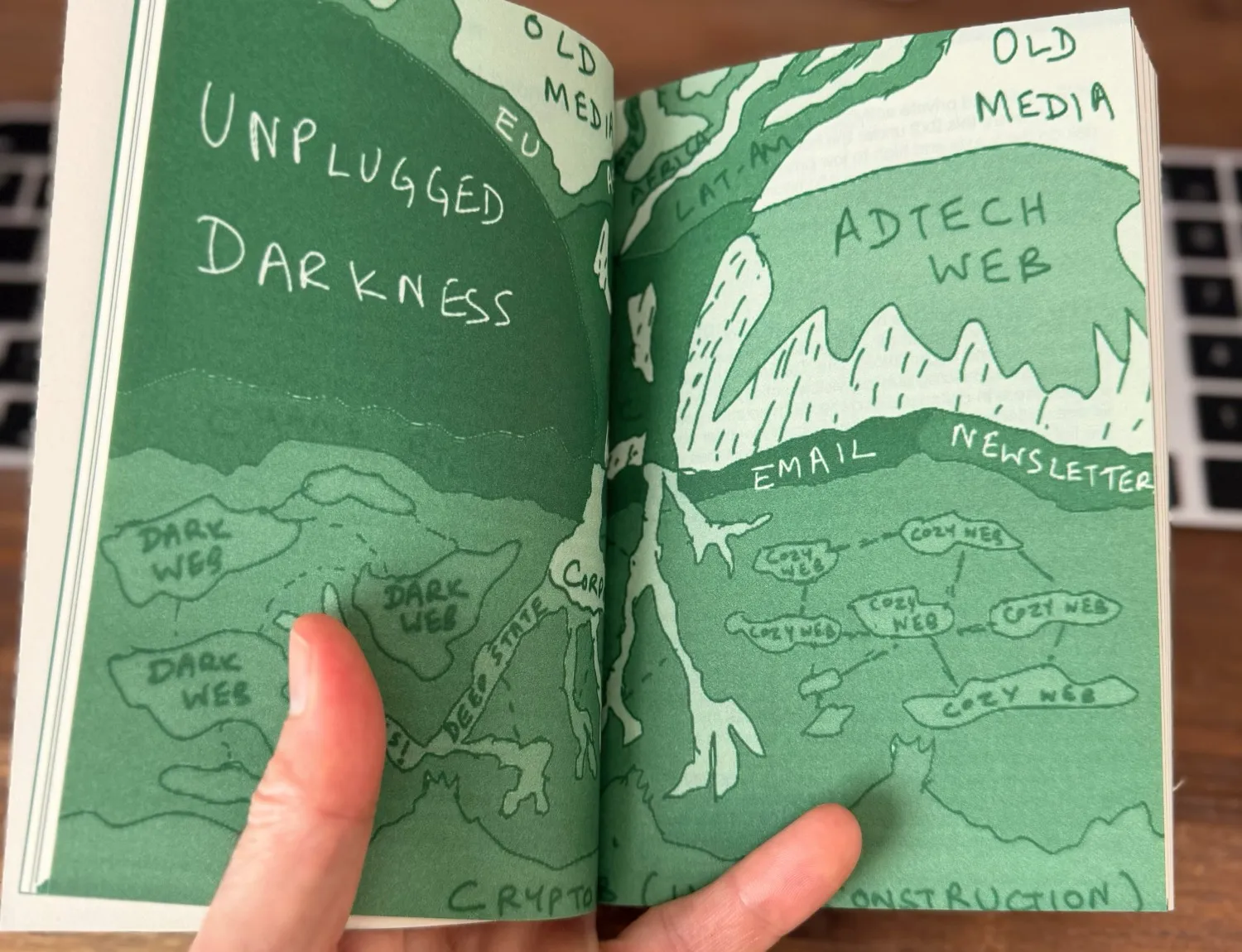
The observation that people are retreating from the noisy, chaotic public web — bots, trolls, algorithmic manipulation, and endless content sludge — into smaller, quieter spaces.
Private communities.
Memberships.
Closed circles.
That shift is real.
And important.
But it only solves part of the problem.
Because leaving the noise doesn’t automatically give you structure.
It just gives you silence.
A quiet space without infrastructure…
… is still fragile.
Still transient.
Still dependent on constant output to stay alive.
What matters is what you build inside that space.
This is the shift.
From publishing…
… to (world) building.
From creating content…
… to constructing infrastructure.
Most platforms are designed to make your work disappear.
Infrastructure is what you build when you decide it shouldn’t.
This is the lens behind everything I’ve been doing here.
The Codex.
(The training within TDWB: The Principles, The Integration, TDW-OS.)
The essays.
The way ideas interconnect.
The way the site is structured.
The way email functions not as a broadcast…
… but as connective tissue.
None of it is accidental.
It’s infrastructure.
And once you see it…
… it’s difficult to go back.
Because you start to see the difference everywhere.
Between things that are designed to be consumed…
… and things that are designed to endure.
If you take this seriously, the question changes.
It’s no longer:
“What should I create next?”
But:
“What am I building?”
~ André
P.S.
And this is why this matters.
“There is a vitality, a life force, a quickening that is translated through you into action, and because there is only one of you in all time, this expression is unique.” — Martha Graham
