Basecamp → The Principles → CYOA
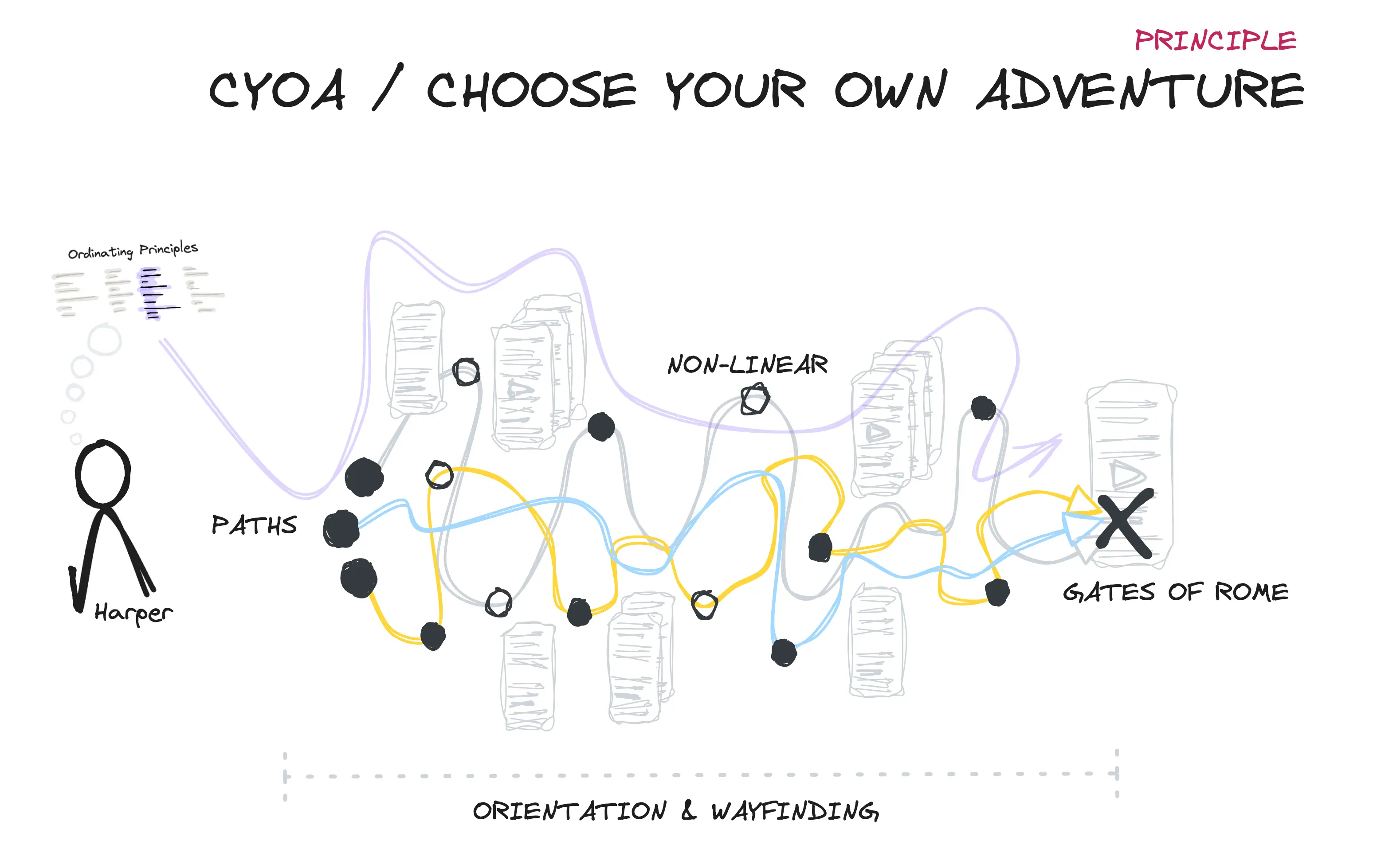
At its heart, CYOA is about agency.
(For the remainder of this section, I’ll use the second-person perspective for reasons that will become clearer shortly. The second-person perspective is a point of view in storytelling, narration, or communication that primarily uses pronouns like “you” and “your” to address the reader directly — you! This perspective creates a more interactive experience, “pulling” you into the narrative.)
There’s you, the architect and engineer of your digital world, a “container” for your audience to inhabit, people like Harper.
Harper, guided by their own inner compass, the Ordinating Principles that drive their desires, frame their fears, and give energy, direction, and forward momentum to their motivations, enter your world, largely an unknown space. And so the adventure starts, the beginning of something…
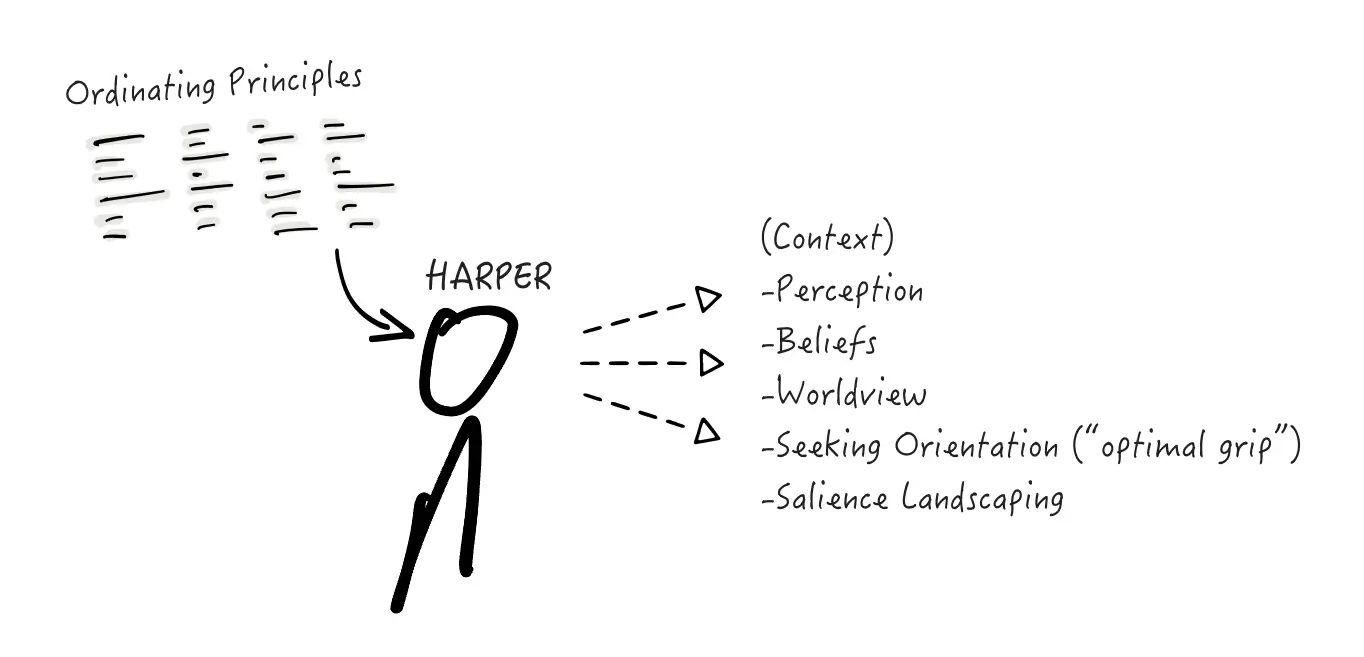
From this moment, you’re engaging in an implicit dance between Harper and yourself in the sacred act of service.
The focus of ‘agency’ is probably the most jarring point of difference between traditional digital marketing and this expression of digital world-building.
At center, the hallmark of traditional digital marketing is an explicit “funnel” experience, where Harper is dropped somewhere at the top of a marketing funnel. To the degree Harper has any agency, it’s little more than an illusion, as they’re nudged, pushed, and cajoled along a linear path that leads to a call to action.
While the experience for Harper can be entertaining and valuable to the degree it’s been designed to be, many funnel experiences are anything but pleasant. However, regardless of the experience, Harper’s intuitive sense that they’re being marched towards a transaction is never far away.
This is not the essence of ‘agency’ you’re designing for.
When someone is said to have ‘agency,’ it means they possess the capacity to act independently and make their own free choices.
Harper may not always have the words to articulate their intrinsic motivations, but they feel them deeply, a magnetic pull toward the experiences and insights that hold the most promise for their growth and fulfillment, whether that’s personal or professional.
As a Digital World Builder, your role is to anticipate and respond to Harper’s unique rhythm. You use the principles of TDW to craft a “dance floor” that feels intuitive, meaningful, and full of possibility.
You create the space and structure for the dance, but Harper’s movements bring it to life.
CYOA is how you invite Harper into the choreography. By offering choices (“doorways”) and engagement, you give them agency in the dance.

You empower Harper to steer their journey in the directions that resonate most deeply with their inner compass (‘Salience Landscaping‘). Each decision Harper makes is a step in the “tango,” a moment of co-creation that shapes the unfolding journey.
The Invisible Conversation, which we’ll explore in the next section, is the ‘invisible dialogue’ that unfolds between the lines of your written words or video content, in the spaces between the ideas you express and the stories you share, as these elements interact and combine with Harper’s internal narratives.
This is the way you, as a Digital World Builder, speak directly to Harper’s inner world. You do this not just through the various ‘doorways’ affording new insights, perspectives, and opportunities, or the information you share on the other side of these doorways, but also through the emotional resonance of your language, the framing of your narratives, and the subtle cues and prompts woven throughout the experience.
CYOA is about agency.
The core insight, however, is that in affording Harper agency, you need not dismantle your marketing funnel. Instead, you architect and engineer it to be implicit, not explicit. And in this shift, everything changes.