Basecamp → The Principles → HEARTBEAT (INTRO) → Part 1.4
I recently listened to a conversation (you can access the full-length paid episode for free using this link) between Sam Harris and Robert Sapolsky (American neuroscientist, primatologist, and professor at Stanford University) about the widespread belief in free will. Putting the controversy of ‘free will’ aside, I loved the simplicity of how Sapolsky explained emergent complexity:
“… I think emergent complexity is like the coolest thing on the planet. The fact that one ant makes no sense and one neuron makes no sense — put a thousand of them together, and the ants make colonies, and the neurons start baby-stepping towards consciousness, and it just emerges with properties that are only describable on the emergent level. A single molecule of water does not possess the property of wetness. Wetness is emergent only at that upper level.”
“… and the whole point of emergent complexity is you start off with some simple components that are stupidly simple, have a very small number of rules for how they interact with the neighbors, and out of that comes complexity. And the amazing thing about complexity is once that happens, those little ants, those single neurons, are still just as simplistic and just as narrow in their options as they were beforehand. It’s not the case that when ants form a whole emergently complex society that suddenly individual ants can speak French or something. They’re still the same simple pieces, and every model that somehow pulls free will out of emergence requires that the building blocks, the constituent parts, have suddenly gotten fancier. And they don’t. And that’s the whole point of it.”
Robert Sapolsky (from 13:35)
Like the simple components in Sapolsky’s description of emergent complexity, each individual expression — a heartfelt letter, a declaration of values, or a personal narrative — may seem insignificant on its own. However, as these elements intertwine and interact, something remarkable takes shape.
Through the artful blend of words, images, and videos, woven together with vivid language and compelling narrative, a sense of ‘ethos’ gradually emerges — the Heartbeat of the World.
It arises not from any single component but from the intricate tapestry they form when combined. Just as wetness emerges from the collective behavior of water molecules, ethos and the Heartbeat of the world emerge from the interconnectedness of our digital expressions.
This emergence is a testament to the power of complexity born from simplicity. Each individual piece remains as it was, but together, they give rise to something greater — an authentic and captivating presence that resonates with others — people like Harper.
And so, with each thoughtful revelation, we contribute to the emergent complexity that breathes life and character into our digital world.
Nothing is inherently special about the three pages I’ll share next (letter, values, and about) or any other combination of pages.
While I will share a helpful framework and demonstrate what I’ve done, these are not meant to be a prescriptive formula or fill-in-the-blank template.
You express yourself in the best language you can, share what you’re comfortable sharing, telling the story you want to tell from your heart.
That’s your starting point.
Public Narrative Framework: Self, Us, Now
Some years ago, I watched Seth Godin answering a question posed by a politician. In answering the politician, Seth cited Marshall Ganz, a professor at Harvard, and briefly unpacked a three-step process he learned from Ganz when he took his course, Public Narrative: Self, Us, Now.
Public Narrative is how we turn values into action — the discursive process by which individuals, communities, and nations construct identity, formulate choices, and motivate action:
- Story of Self
- Story of Us
- Story of Now
By externalizing and articulating these three stories, we can earn the trust and attention of the people we seek to serve.
A free online version of Public Narrative by Marshall Ganz can be found here (and a PDF workbook here, with other archives here and here).
You’ll see these three dimensions reflected across the three pages I’ll share next (Letter from André, Values, About), my manifesto (and other pages I’ve since created).
Embodying Ethos
When we recognize these two dimensions:
- Ethos (externalizing our values) and
- Ordinating Principles (our intrinsic values and driving motivation, which is also a reflection of our audience like Harper),
… we have the ingredients to shape the message our digital world implicitly broadcasts like a beacon — its Heartbeat — pulling the right people in and repelling the wrong people away.
First, we establish a sense of ethos within our digital world. We do this by revealing parts of us that, at some point, contribute to the emergence of this “felt” feeling of ethos — the Heartbeat of our World. For me, I expressed this in a few ways:
By blending these interconnected parts, we lay the foundation for the emergence of ethos by revealing facets of our identity.

On the homepage, I externalized a personal story, framing the next chapter in my journey:
Upon turning fifty on March 7th this year (2023), I became acutely aware of how short our time on earth is. I found myself coming to grips with a renewed sense of purpose, a fresh and vibrant drive to find a deeper, more profound meaning in life’s second half.
In recognizing this, I needed to honor it and embark on the next phase of my journey, free of regret.
I’m using this website as the canvas for this “next chapter,” which seems fitting because it’s where this journey began twenty years ago. I suspect this will be a decade-long project (if AI doesn’t take over first, rendering me irrelevant).
The personal letter talked about this project you’re now a part of, which feels a little like magic to me.
I also externalized my core values to a ‘values‘ page. I’ll revisit this page repeatedly, adding, removing, and tweaking the language to express the virtues I hold dear more clearly.
This is about externalizing the values and principles that get me out of bed in the morning. It’s not goal-driven. It’s about enjoying a journey (the process of being a professional creator) that enriches me, making me feel alive.
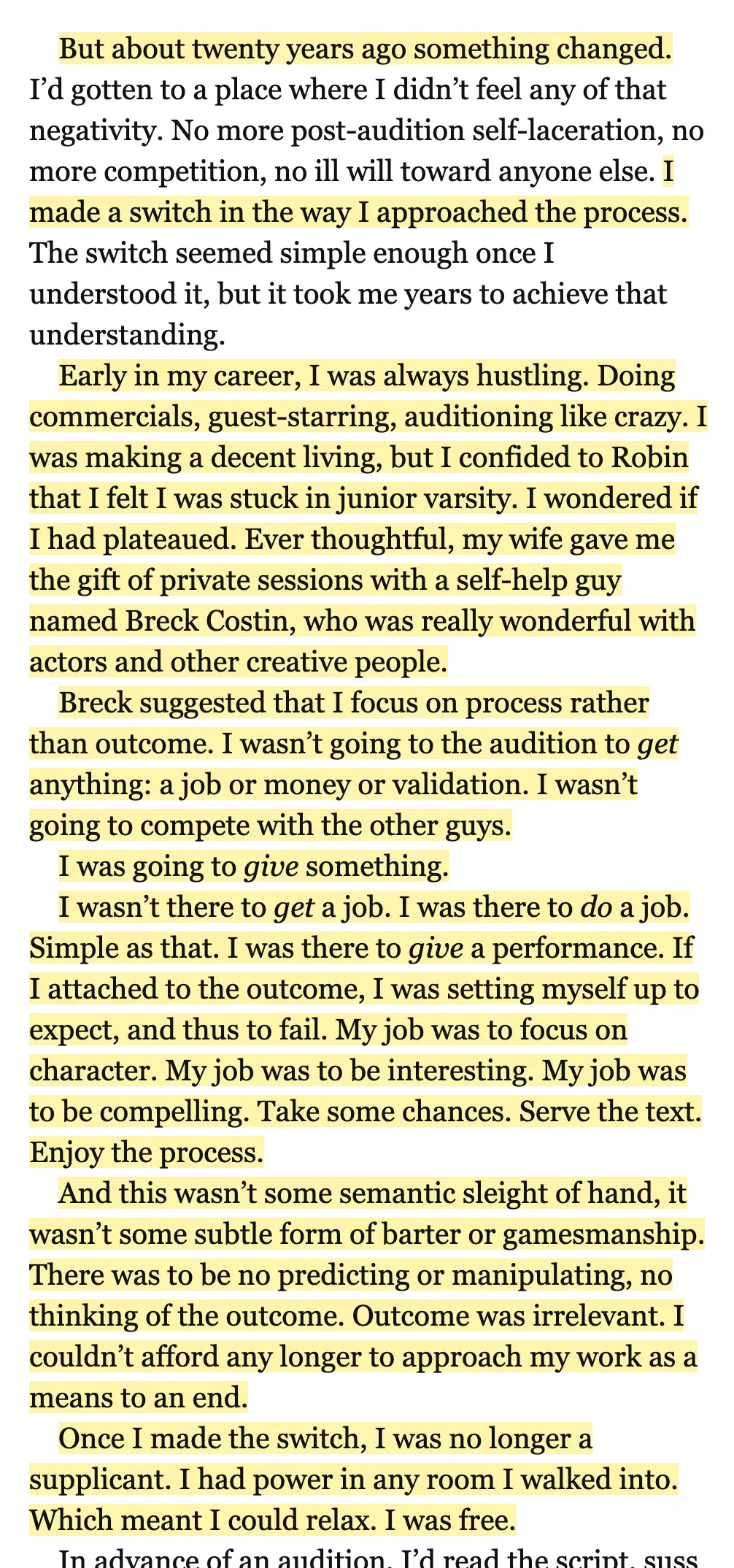
Years ago, I read Bryan Cranston‘s autobiography, A Life in Parts. I love a good autobiography (Open by Andre Agassi remains my favorite). My Kindle book is full of highlights and bookmarks, yet this excerpt hit me, and I’ve never forgotten it:
Finally, I created a short ‘about‘ page that explains my backstory (how I got here) a bit more. It also links to the personal essay about Why I Write.
These parts come together within the context of the larger digital world to elicit a sense of who I am, what I care about, and the journey I’m on (which loosely fits Marshall Ganz’s framework).
Implicit in all this is an “invitation” to come on this journey with me if it resonates.
The Yin-Yang of Ethos
This next part may seem counterintuitive and controversial at first.
While someone’s Ordinating Principle across a particular dimension (health, wealth, etc.) reflects their intrinsic needs and motivations, we don’t need to guess what they are. We can’t know, of course, not precisely. So, in this respect, doing traditional customer research can often be a misleading pursuit.
I feel I can make this claim because, in many cases, our audience — the Harpers of our worlds — rarely has the language to describe their intrinsic needs, beliefs, and motivations clearly. They may intuit some of it like I did when externalizing Frank and Matt, but without explicit language, it’s just feelings bubbling about their head without the structure of language.
The insight is that our own ordinating principle, across a particular dimension, is directionally a reflection of other people like us.
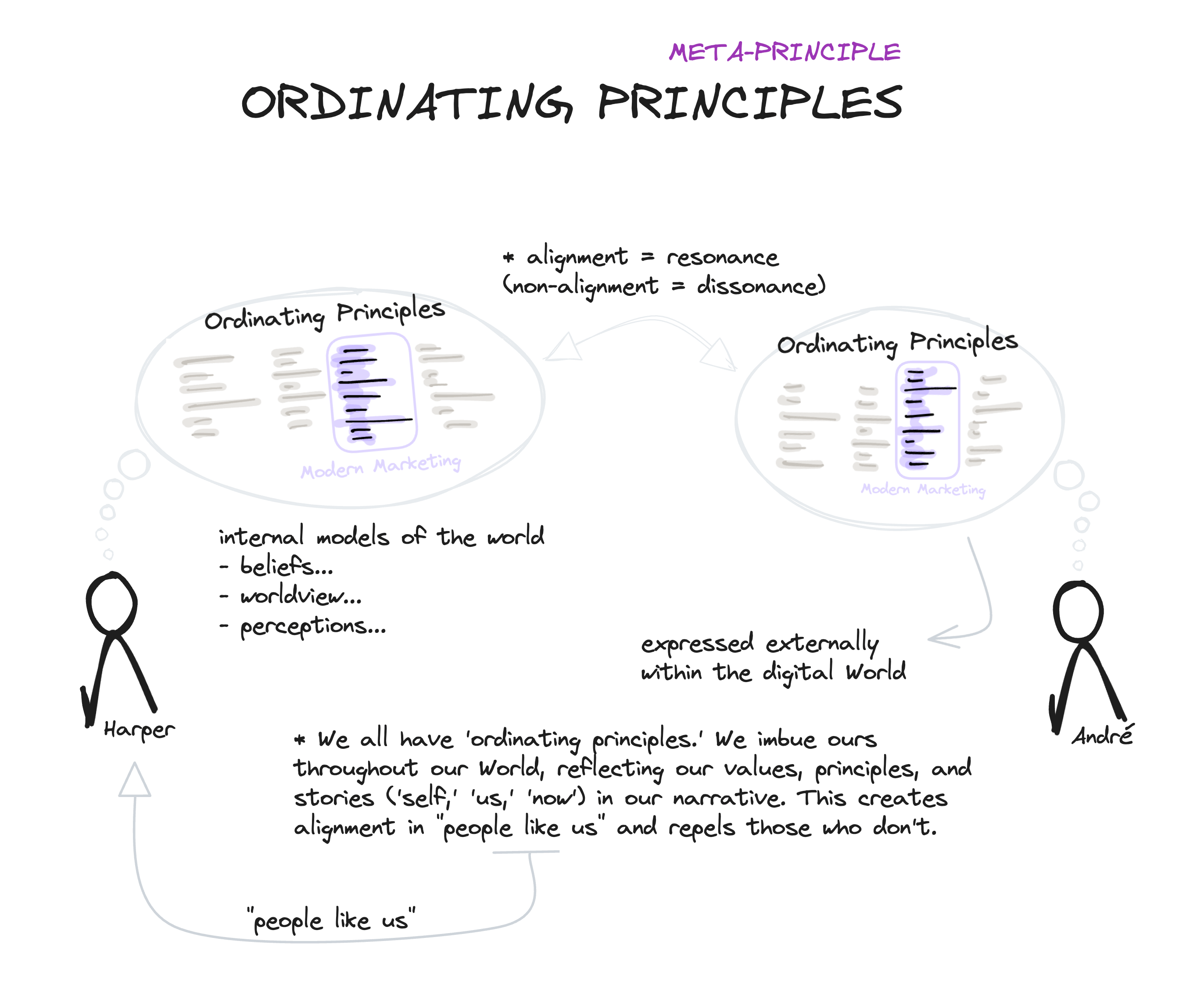
As Seth Godin says, “People like us do things like this.”
For example, Petter Attia didn’t need to do customer research to develop the concept and framework for this Centenarian Decathlon. That insight came from within him, born from years of seeing health and fitness one way and, with the wisdom of age, perspective, and experience (he’s the same age as me), seeing it differently.
By externalizing his insights into a mental model and framework and giving it a name (Centenarian Decathlon), he dimensionalized it — not just for himself more clearly, but he gave language to people like me (“People like us do things like this”).
Linger on this insight for a moment.
This is what I did here with TDW.
During those months when I couldn’t publish any of TDW here on my personal website, I used that time to externalize my ordinating principles about how I see modern marketing and digital world-building.
I captured it into a manifesto.
At the end of my “Letter from André” message, I wrote this:
If this resonates with you, I’ve written a Manifesto — a call to arms for sovereign creators like us in how we seek to attract and grow audiences that matter.
It briefly framed the manifesto, inviting people to read more if what they had just read resonated with them.
The manifesto reflects my position and worldview, pitting me against ideals I disagree with within the industry I have spent twenty years operating in. It doesn’t pull punches. I speak directly about what I don’t like about traditional funnel-based marketing and advertising-funded platforms, presenting an alternative narrative that reflects a different perspective.
I’m careful not to blame anyone for their choices.
Sadly, in a weird and dialectical paradox, you’re likely locked into doing the same to your audience to some degree, under the misguided assumption that this is just “how it’s done,” part of the digital marketing playbook — best practices for doing business online.
This alternative perspective encapsulates and wraps language around building a different “sausage-making” machine that allows us to feel alive doing the work we love for people we care about serving.
The manifesto is a call to arms because that’s precisely what it does.
Just as Peter Attia’s Centenarian Decathlon has framed a perspective and created a mental model around healthspan (your quality of life), not just a longer lifespan, I framed a perspective of modern marketing free from the cohesive nature of traditional digital marketing when tethered to the principles of direct-response that emphasize coercion.
I know this worked because I’ve received so many ‘love notes’ from people after reading it, saying that I’ve given language to something they’ve felt for so long but could not articulate succinctly.
This one-two punch causes resonance in the right people, dissonance in the wrong people, and an encounter with paradox in others, causing them disorientation (which is a good thing, but more about this later).
§
With the building blocks of ethos in place, the next step is establishing a clear position in the world (the broader market as it relates to who we’re serving and our skills and expertise). This isn’t a value proposition, although it’ll be bound to that later when an offer is presented.
By stating my position within the market, I implicitly “connect with” an ordinating principle that Harper also cares about. Through this coming together of Ordination Principles, a bond is established — resonance.
(Or an encounter with paradox and disorientation. But don’t mistake disorientation for dissonance — they’re very different, but I’ll cover this later.)