Basecamp → The Principles → Orientation & Wayfinding
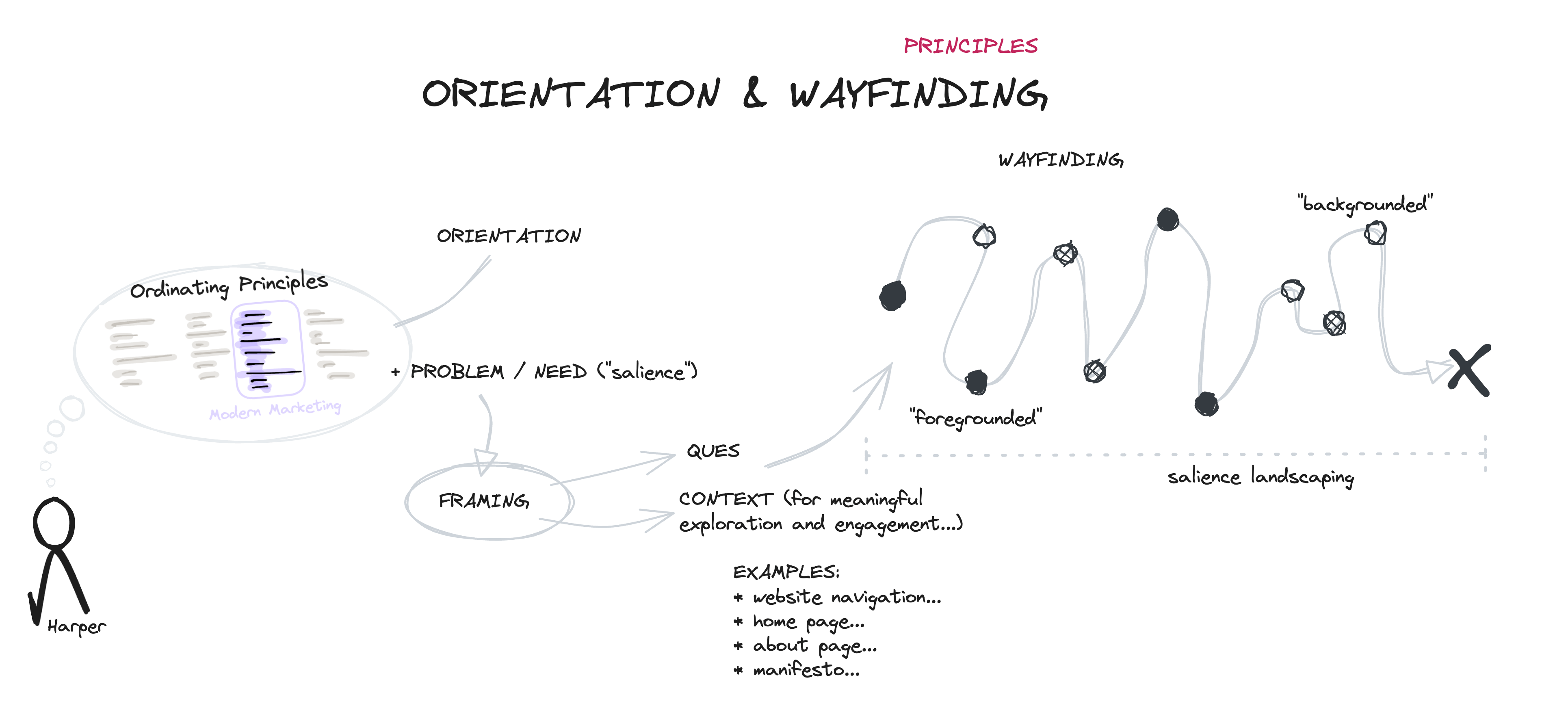
Orientation and Wayfinding are principles for orienting and guiding users like Harper within our digital world.
Orientation introduces Harper to the structure of the digital world. It provides cues and context for meaningful exploration and engagement, framed and colored by their needs and biggest problems.
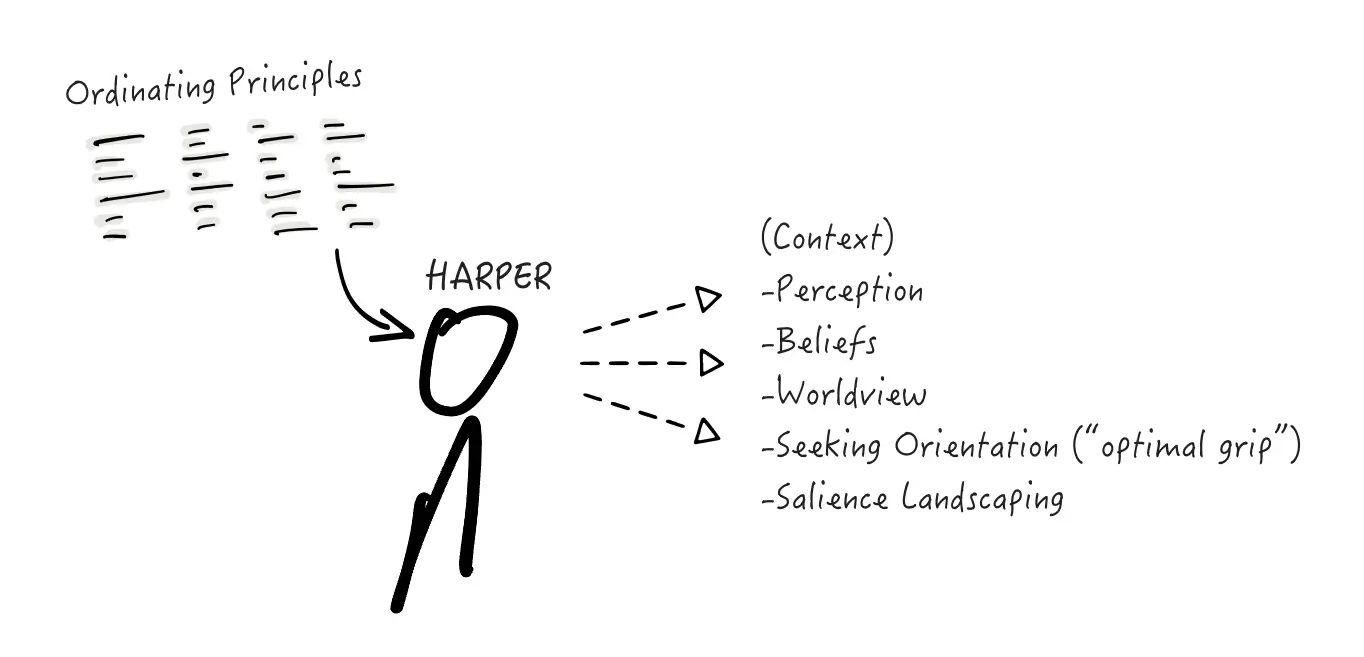
As Harper engages with the digital world, their Ordinating Principles act as a compass, helping them navigate the complex landscape of information, ideas, and perspectives. These principles provide a framework for making sense of the world — discerning what’s valuable, salient, and worthy of their attention.
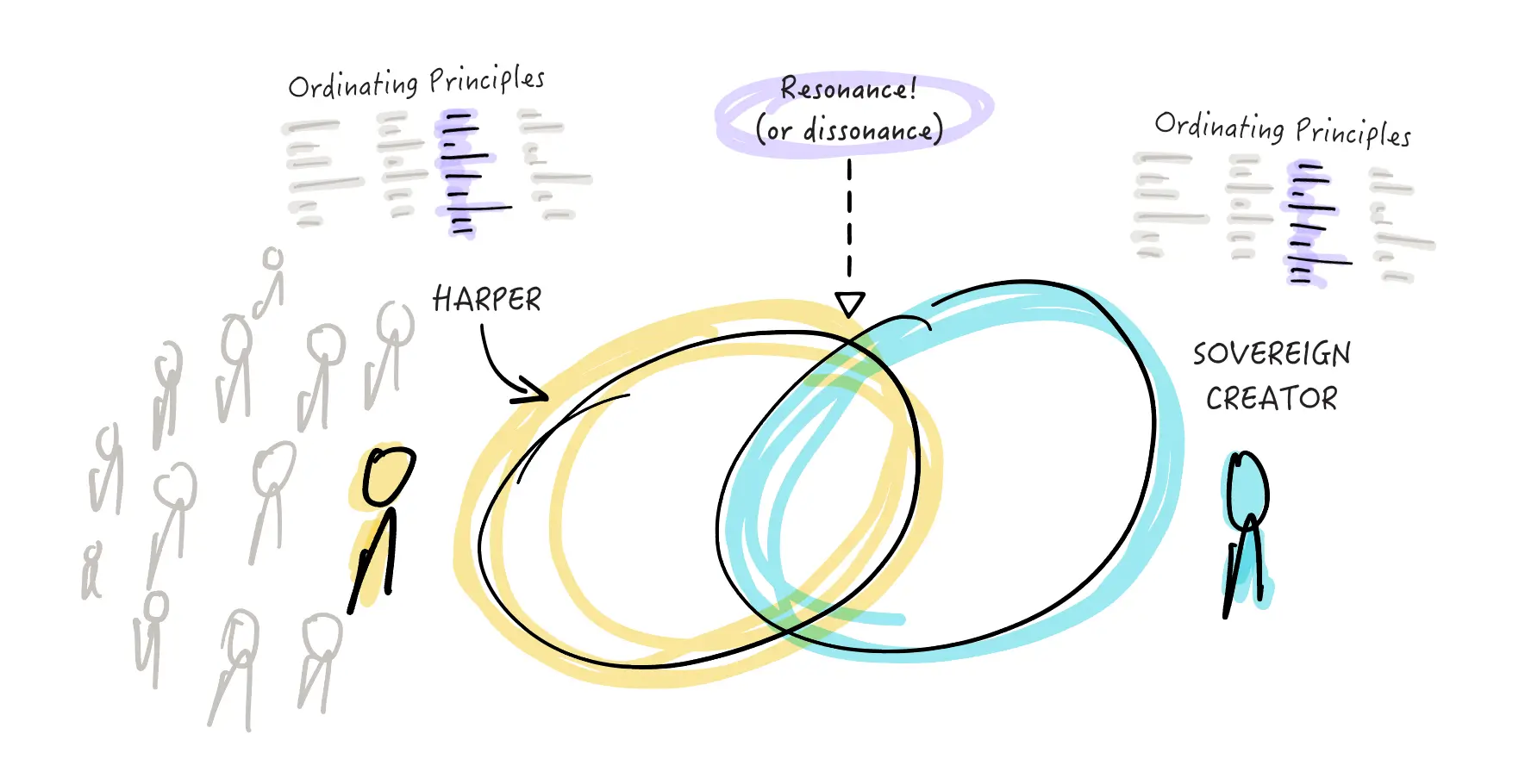
Wayfinding builds upon orientation, providing the structural framework for navigating within the digital world. It offers choices through website navigation, sitemaps, breadcrumbs, context, and hyperlinks, etc.
The interplay of design, content, and user experience allows Harper to quickly orient to what’s most relevant to them at any given moment, foregrounding what seems important now while backgrounding other elements.
Harper’s journey, needs, and motivations shape their salience landscape, causing shifts in what they perceive as relevant and important at any moment.
This dynamic and recursive process of Orientation and Wayfinding is crucial for setting expectations and helping Harper navigate the initial steps within the digital world. It illustrates how the digital experience adapts based on salience, interaction, engagement, and feedback loops.
While not explicitly shown in the image, these principles eventually lead to encounters with paradox and disorientation, setting the stage for deeper engagement through mechanisms like CYOA (Choose Your Own Adventure) and Invisible Conversations, which offers reflective, asynchronous engagement supporting the development of new insights.
§
Introduction
In this section, we’ll discuss the principles of Orientation and Wayfinding together because they are closely intertwined. These two principles describe an integrated approach, where wayfinding serves not only as a means of navigation but also as an essential component in establishing orientation from the outset.
Before we launch into the meat of this section, I want to draw attention to a form of perspective called perspectival knowing, which, according to John Vervaeke, is one of the 4Ps of Knowing.
This is important because I draw on some concepts informed by John’s teaching that have had a profound influence on me (pulled from his lectures on Awakening from the Meaning Crisis and After Socrates).
Part of perspectival knowing is “salience landscaping,” which, from our perspective in any moment (situational awareness), is how things stand out (and other things don’t).
The simplest way to think about this is if something is salient to me (or you), it’ll be foregrounded; if it’s not, it’ll be backgrounded.
The goal of salience landscaping is to “foreground” certain things and background others in an effort to get an optimal grip (orientation) of one’s environment and interact with it well. When we do this well, we’re said to have situational awareness.
Perhaps reread the previous few paragraphs again. This is really the project of orientation and wayfinding.
In architecting and engineering our digital world, we must consider our audience’s perspective (Harper). It’s our job as world-builders to provide Harper with situational awareness as quickly as possible.
Once again, it’s worth drawing attention to the premise of Mechanism Design Theory (MDT):
What’s interesting about the concept is that it involves designing a game or situation so that the desired outcomes occur when each participant acts in their own self-interest.
By having a sense of Harper’s perspective, we get to “foreground” certain elements of our world (through wayfinding) and “background” others based on situational context, giving Harper a sense of situational awareness (orientation).
For context, I’ll start with the 4Ps of Knowing, emphasizing perspectival knowing for this lesson, then move to the Codex before continuing.
According to John Vervaeke, the 4Ps of Knowing are:
- propositional knowing (knowledge of facts)
- procedural knowing (skills, sequences of activities)
- perspectival knowing (what it’s like to be)
- participatory knowing (the knowledge of what it’s like to play a certain role in your environment or relationships)
“… you know what it’s like to be you now in your state of mind in this situation. You know what you’re foregrounding, what you’re backgrounding, you know what is salient for you. You can sense how the salience is shifting around. You got a sense of how you’re fitted to this situation.
This doesn’t result in skills or beliefs. It results in perspectives, and you know how to take perspectives, and you know what the difference between perspectives are and how valuable it is to have multi-perspectives on a situation.
Sometimes, in order to solve a problem, you shift to a different perspective. And so perspectives aren’t true or false, they’re not powerful or not, their standard of realness is presence. How present are you in this situation?”
John Vervaeke on the Tim Ferris Show (2:26)
“perspectival knowing this is knowing what it’s like to be you here now in this situation in this state of mind, the whole field of your salience landscaping what it’s like to be you here now…”
John Vervaeke on the Lex Fridman Podcast (1:23:12)