Most people get this backwards.
They focus on how to get more people before they’ve built something worth finding.
That mistake is easy to miss because the questions sound reasonable:
- How does demand form?
- How do people discover what you’ve built?
I received two emails on the same day asking versions of exactly this.
Different people. Different situations.
Same underlying tension.
They were treating these as separate questions. That’s where things start to break.
They’re not.
They’re two sides of the same system.
So I’ve written this as a two-part essay.
This first part focuses on how demand forms.
The second explores how people encounter that demand — discovery, reach, awareness.
They’re intertwined.
But not interchangeable.
Order matters.
Start with discovery, and you optimize for attention before there’s anything meaningful to find.
Start here, and you build something that can actually hold attention once it arrives.
⦿
I received an email recently that gets right to the heart of this:
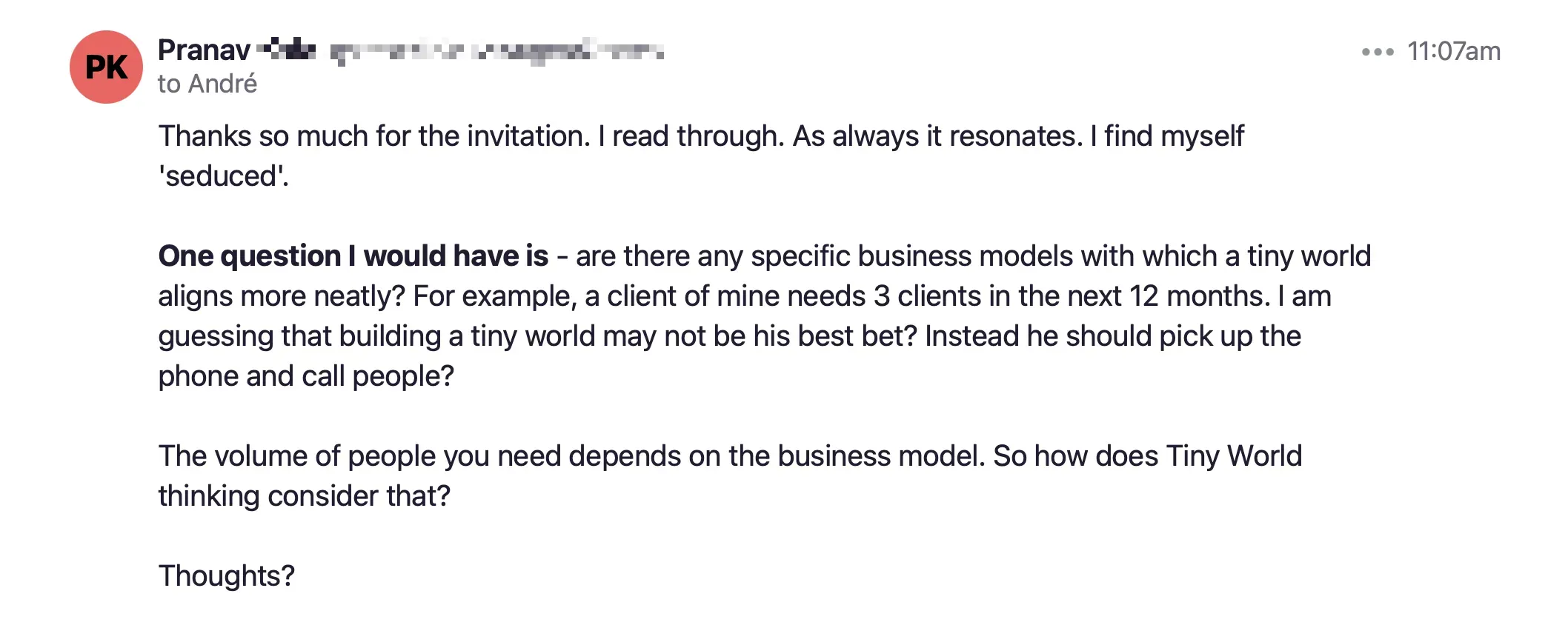
Short answer?
Yes. In that scenario, picking up the phone is likely the correct move.
And that’s exactly where the confusion starts.
Because what he’s describing isn’t what a Tiny Digital World is designed to do.
They’re two different ways of operating.
Two Different Games
Let’s separate these clearly.
There are (at least) two ways to generate business:
1. Direct Acquisition
You know who you want. You go and get them.
- outbound
- targeted
- immediate
- controlled
- finite
Calls. Emails. Outreach. Referrals.
It works.
And in certain situations — like needing 3 clients in 12 months —
it’s not just viable, it’s the right tool.
2. Environment-Based Demand (Tiny Digital Worlds)
You have a sense for the type of person you want to attract. Not psychographic or demographic specifically, but rather, “people like me.”
When most people think about “their people,” they approach it like a selection problem:
Who are they?
What traits do they have?
Where do I find them?
How do I attract them?
That leads to:
- avatars
- psychographics
- positioning exercises, etc.
Which all assume:
If I define them clearly enough … I can go get them.
What I’m proposing is a different model entirely.
Not selection…
But emergence.
Instead of trying to find your people directly, you:
- express your Ordinating Principles
- articulate your Story of Self / Us / Now
- shape an environment (a “World”) around those
In doing that, something interesting happens:
People don’t get “targeted” into your world…
They interact with it.
And through that interaction:
- some feel resonance
- some feel dissonance
- some lean in
- some drift away
That process is the filtering.
And it’s not something you manually control.
It’s something the system does. It’s:
- inbound
- emergent
- slower (at first)
- compounding
- trust-driven
You’re not directly “getting clients.”
You’re building an environment where:
- the right people recognize themselves
- trust forms over time
- demand emerges as a byproduct
This is a different game.
And most of the confusion comes from trying to use one like the other.
What a Tiny Digital World is (and isn’t)
A Tiny Digital World is not:
- a faster way to get clients
- a replacement for outreach
- a short-term pipeline fix
It’s not designed for:
- urgent revenue needs
- low-volume, high-certainty acquisition
- situations where you already know exactly who to contact
In those cases?
Don’t build a world.
Pick up the phone.
So what is it doing?
A Tiny Digital World is solving a different problem:
Not:
“How do I get clients?”
But:
“What happens when someone encounters my work?“
Because here’s the uncomfortable truth:
Most people don’t have a demand problem.
They have a:
- resonance problem
- retention problem
- trust problem
People arrive…
… and nothing meaningful happens.
They skim.
They leave.
They forget.
So the conclusion becomes:
“I need more traffic.”
When the real issue is:
“What I’ve built doesn’t create demand.“
Demand is not created the way you think
Demand isn’t something you manufacture with:
- better hooks
- tighter funnels
- more persuasive copy
That can generate transactions.
It doesn’t create the kind of demand that compounds.
The kind that compounds when three things start to click:
- Clarity — what this is, who it’s for, why it matters
- Resonance — this feels like it’s for me
- Trust — I believe this … and I believe you
That doesn’t happen in one interaction.
It happens over time — as someone moves through your work.
What the system is actually doing
This is why the focus inside a Tiny Digital World looks the way it does:
- Artifacts — work that endures
- Orientation — helping someone understand where they are and how parts of the world relates to them
- Wayfinding — how they move through your world
- Ethos (consistency of signal) — the same worldview, everywhere
Individually, these don’t feel like “marketing.”
Together, they create something very different:
A place that can hold attention.
A place that deepens understanding.
A place people return to.
Where people get this backwards
They focus on:
“How do I get more people?”
Before asking:
“What happens when people arrive?”
So they optimize for attention without building anything that can metabolize that attention.
Which creates a loop:
- Get traffic
- Nothing happens
- Assume more traffic is needed
- Repeat
Demand forms through interaction, not exposure
Most marketing models assume:
- Exposure → Interest → Conversion
What actually happens (when it works) looks more like:
- Exposure → Orientation → Resonance → Return → Trust → Demand
Demand is not the first step.
It’s the result. It emerges downstream.
And if you try to force it early, you compensate with:
- urgency
- pressure
- persuasion
Which might convert but doesn’t compound.
Starting from Zero
This is where a lot of the anxiety sits.
“No one is seeing this.”
That’s real.
A Tiny Digital World does not eliminate early silence.
You may have:
- no readers
- no replies
- no signal
But the meaning of that silence changes.
Instead of:
“This isn’t working”
It becomes:
“I’m building something that will matter when the right people arrive.“
That shift matters more than it seems.
The part that’s harder to explain (but real)
Over time — if the system becomes coherent — something else tends to happen.
Carefully stated:
Demand starts to form without being explicitly engineered — a type of “gravitational pull” can be observed.
You start to see small signals:
- people referencing your ideas back to you
- your language echoed in their thinking
- someone arriving already half-oriented to how you see the world
People:
- find your work
- share it
- return to it
- respond to it
Not because you optimized for conversion but because what you built holds them.
This isn’t a mechanism you can rely on.
It’s a pattern I’ve observed.
The cleanest way to think about it
You’re not trying to create demand directly.
You’re trying to build something where demand forms as a byproduct.
TL;DR
If you need 3 clients in the next 12 months: call people.
If you want to build something that:
- compounds
- attracts the right people
- deepens over time
Build a Tiny Digital World.
Different tools.
Different timelines.
Different problems entirely.
~André
