In Part 1, I said I’d received two emails on the same day asking versions of the same underlying question.
This is that question.
Or rather, this is my slightly edited, combined reply.
Because while the wording was different, the tension underneath was the same.
Pranav asked it one way:
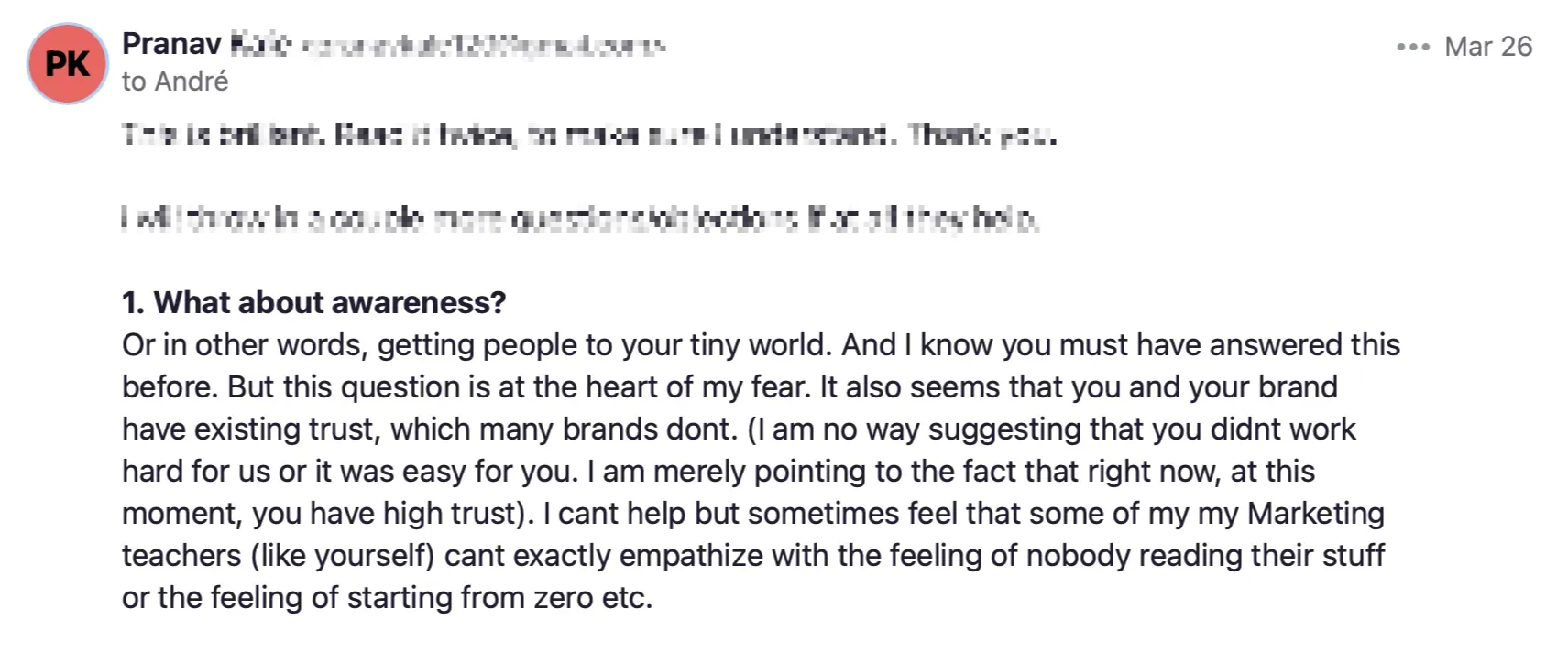
What about awareness?
What about getting people to your World?
What if you’re starting from zero?
Sean asked it another:
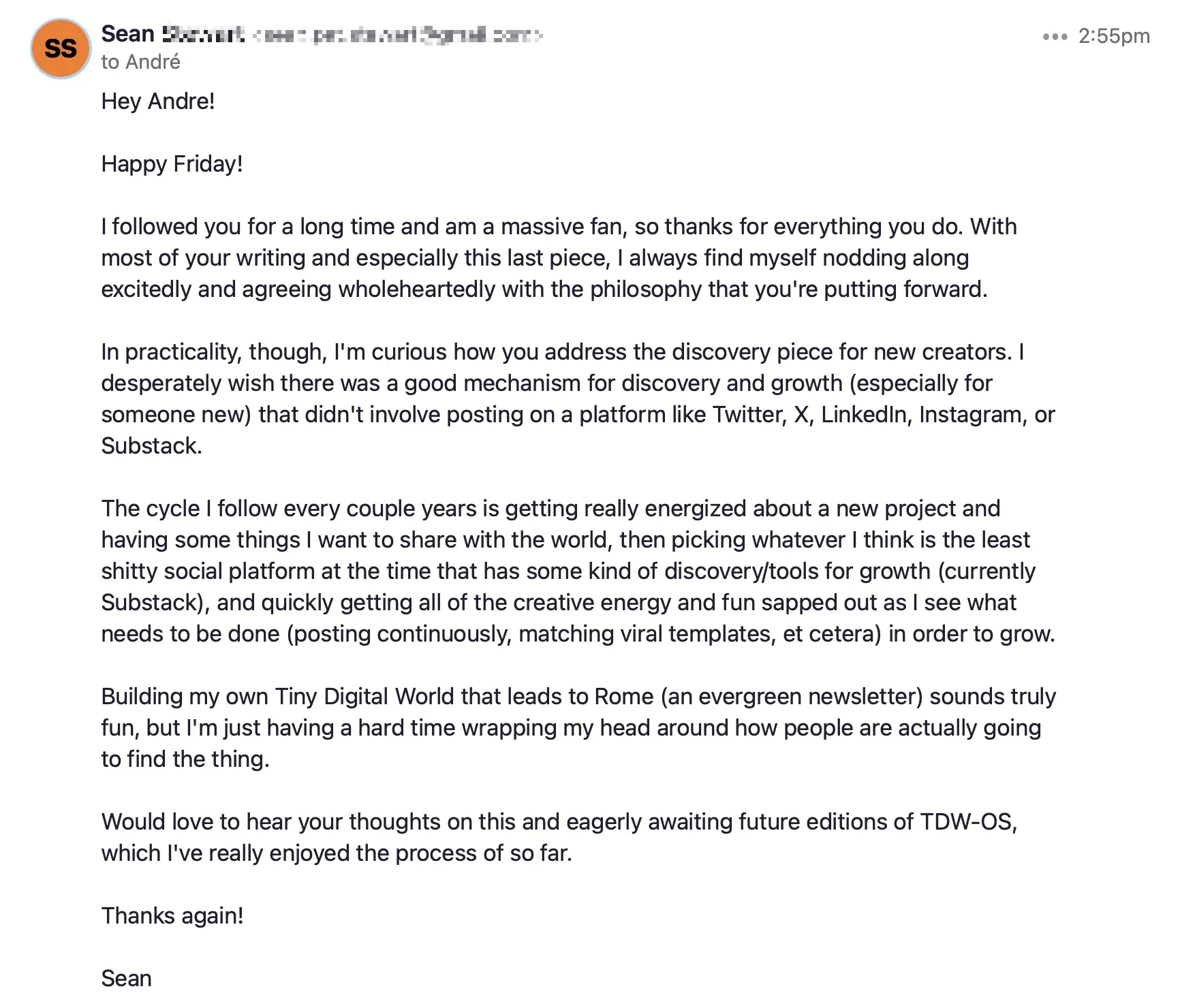
What if I’m willing to build something deeper…
… but every path to “growth” seems to pull me back toward platforms, performance, and becoming someone I don’t want to become?
Different language.
Same ache.
Both are circling the same fear:
What’s the point of building a Tiny Digital World if no one ever finds it?
That’s the question.
And it matters, because this is exactly where people tend to assume I’m either dodging the hard part…
… or romanticizing something I no longer have to deal with.
So let me answer it as cleanly as I can.
First: yes, the fear is real
Underneath the discovery question is a very real concern:
If I don’t actively push myself out into the world … nothing will happen.
No readers.
No traction.
No signal.
Just silence.
That is not irrational.
Especially early on, it may even be true.
So I want to begin there, because I don’t think this question should be brushed aside with some airy: “Just make great work and people will come.”
Sometimes they won’t.
Sometimes they don’t.
Sometimes for longer than feels emotionally reasonable.
And if you’re at the beginning, or rebuilding, or trying to create something outside the dominant systems of visibility, that silence can feel brutal.
Not poetic.
Not noble.
Not character-building.
Just discouraging.
So no — I don’t think the fear is silly.
I think it’s honest.
Second: a Tiny Digital World does not solve discovery
This is where I need to be very explicit.
A Tiny Digital World does not solve discovery.
It doesn’t try to.
It is not a traffic strategy.
It is not a reach mechanism.
It is not a hidden growth hack dressed up in prettier language.
There are countless ways to reach people:
- social platforms
- guest writing
- partnerships
- search
- referrals
- outreach
- paid media
- being mentioned by others
- plain old luck
That layer — the act of getting in front of people — is tactical, unstable, and context-dependent.
It changes constantly. (And always will.)
What works in one season stops working in the next.
What works for one person distorts another.
What feels tolerable to one creator feels spiritually corrosive to the next.
That is precisely why I separate it from the thing I’m talking about here. Because Tiny Digital Worlds are solving a different problem.
Not:
How do I get people to see me?
But:
What happens when they do?
That is the actual concern.
That is the thing most people skip past.
The deeper problem is usually not discovery
A lot of people assume they have a traffic problem.
Sometimes they do.
But very often, they have something else:
a resonance problem
a retention problem
a trust problem
People arrive…
… and nothing meaningful happens.
They skim.
They bounce.
They leave with no deeper sense of what they’ve encountered.
Nothing holds.
Nothing lingers.
Nothing invites a return.
So the diagnosis becomes:
I need more traffic.
When the deeper truth is:
What I’ve built doesn’t metabolize attention.
It doesn’t turn exposure into orientation.
It doesn’t turn curiosity into trust.
It doesn’t turn a passing encounter into the beginning of a relationship.
And because that part is weak, the only available move is to keep feeding the machine more attention.
More content.
More posting.
More volume.
More reach.
More effort spent dragging people to a door that opens into very little.
That loop is exhausting!
And worse, it teaches the wrong lesson.
It teaches you to think the answer is always more distribution.
Sometimes the answer is: Build a better place for people to arrive into.
This is where Sean’s tension matters
Sean described a cycle that I suspect a lot of people will recognize.
You get excited about a new project.
You have ideas.
Energy.
A sense of possibility.
Then comes the practical question:
How will people find this?
So you pick the least awful platform available at the time.
You start showing up there.
You try to make peace with its mechanics.
You tell yourself it’s just a tool.
And then, slowly, almost imperceptibly, the thing begins to change shape.
Your attention bends toward what performs.
Your expression bends toward what travels.
Your thinking bends toward what the environment rewards.
And before long, the project that felt alive in your hands starts to feel like content inventory.
That’s not a motivation problem.
That’s a system mismatch.
Because most platforms do not merely distribute your work.
They (intentionally) exert pressure on it.
They reward frequency.
They reward legibility.
They reward conformity disguised as originality.
They reward staying in motion.
They reward being instantly graspable.
They reward whatever keeps the wheel spinning.
And if you stay inside that long enough, it doesn’t just affect how you promote.
It affects how you think.
Which means the real question isn’t simply:
How do I grow?
It’s often something more uncomfortable:
How do I grow without being gradually reshaped by the environment I’m using to grow?
That’s a much better question.
And it’s one of the reasons I care so much about distinguishing distribution from home.
Use the bridge. Don’t live on it.
You still need ways for people to encounter your work.
Especially in the beginning.
There is no escaping that.
But I think the cleanest way to think about this is:
Use whatever distribution layer you can tolerate … but treat it as a bridge, not a home.
That might be:
- writing on a platform for a while
- guest appearances
- podcast interviews
- direct outreach
- collaborations
- search
- referrals
- paid traffic
- communities you already inhabit
- a social channel you don’t actively despise
I’m not doctrinaire about the mechanism.
The mechanism is not sacred.
What matters is whether it helps people “cross the bridge” into a place where the relationship can deepen.
Because the goal is not:
Winning on the platform.
It’s:
Bringing people into a world that can hold them once they arrive.
That distinction matters more than it first appears.
Because when the bridge becomes the home, you end up optimizing for the bridge.
And then, before you know it, the entire project starts serving the distribution layer instead of the other way around.
Starting from zero changes the emotional texture, not the logic
Pranav raised something fair.
He said, in effect:
It’s easy to say these things when you already have trust. Can you really empathize with what it feels like to start from zero?
That deserves a real answer.
First: yes, that feeling is real.
Starting from zero can feel humiliating.
You publish something and no one replies.
You build something you care about and it appears to vanish into the void.
You look around and everyone else seems to have momentum, history, signal, reputation, proof.
Meanwhile, you have a blank page and a quiet room.
That’s hard.
But here’s the nuance I’d offer:
Everyone starts at zero.
Not everyone stays there for the same length of time.
Not everyone starts from the same conditions.
Not everyone has the same advantages, disadvantages, or prior credibility.
But zero is still zero.
And the real split tends not to be between people who started with attention and people who didn’t.
It’s between people who, in the silence, built something worth returning to…
… and people who responded to the silence by contorting themselves into whatever might produce a faster signal.
That sounds harsher than I mean it to.
I’m not criticizing the instinct.
I understand the instinct.
Silence creates pressure.
Pressure creates urgency.
Urgency creates compromise.
That is profoundly human.
But it’s also why this distinction matters so much.
Because a Tiny Digital World does not eliminate the early silence. What it does is change what that silence means.
Instead of:
No one is here, so this must not be working.
It becomes:
I am building something that will matter when the right people arrive.
That is not a small shift.
It changes your posture.
It changes what you tolerate.
It changes the kind of work you’re willing to keep making before external proof appears.
And yes, that requires a certain kind of faith.
Not faith that success is guaranteed.
Nothing is guaranteed.
I mean faith that building something coherent is not wasted effort simply because the room is quiet.
The harder part to explain
There is something else I’ve observed.
And I want to say this carefully, because I do not want it mistaken for a promise or a tactic.
Over time, when a World becomes more coherent…
when its artifacts begin to connect (and interconnect)…
when the signal sharpens…
when the ethos becomes legible across the whole environment…
… something like gravitational pull can begin to form.
Not immediately.
Not predictably.
Not on command.
But you begin to notice small signals.
People reference your ideas back to you.
Your language starts showing up in their thinking.
Someone arrives already half-oriented, as if they’ve spent time in your world before you ever meet them.
Your work gets shared in places you didn’t expect.
It circulates quietly.
It returns through side doors.
People find one artifact, then another, then another.
They begin to assemble a picture.
Trust forms without being manually engineered at every step.
Again: this is not a mechanism to rely on.
It is not a recipe.
It is a pattern.
And I think people miss it because they’re trained to look only for obvious metrics of traction: follower counts, spikes, velocity, visible virality.
But not all pull announces itself loudly.
Sometimes it feels less like a campaign succeeding and more like a current gradually strengthening beneath the surface.
That has certainly been my experience.
Not because I had some master plan for traffic.
Not because I solved awareness in a definitive way.
And not because I think this somehow absolves us from having to get in front of people.
But because coherence itself seems to have consequences.
A well-formed world has a way of increasing the odds that meaning survives contact.
And that matters.
Discovery is upstream. Demand is downstream.
This is the core thing I want to keep clear.
Discovery matters.
Awareness matters.
Reach matters.
But they are upstream variables.
They are not the whole game.
They are not even the most important part of the game.
Because discovery gets people to your door.
What you’ve built determines whether they:
- understand what they’ve found
- feel something when they encounter it
- trust it
- return to it
- move deeper into relationship with you over time.
Most people obsess over the door.
Very few build the house.
Or to say it another way:
Most people try to solve the problem of visibility before they’ve solved the problem of significance.
And when you reverse the order like that, you end up optimizing for attention before there is anything meaningful for attention to land on.
That’s the trap.
So what should you do in practice?
You still need some form of distribution.
Pick one.
Pick one you don’t hate.
Pick one you can sustain.
Pick one that does the least violence to your mind.
Pick one that does not slowly train you to betray the deeper logic of what you’re building.
Then use it.
But hold it lightly.
Don’t confuse the bridge for the destination.
Don’t confuse reach for relationship.
Don’t confuse visibility for demand.
Don’t confuse activity for depth.
Use distribution to create encounters.
Then let the World do what it’s meant to do:
orient
filter
resonate
deepen
hold
compound
That’s the work.
Not glamorous, perhaps.
Not instantly legible in an age obsessed with speed and hustle.
But real.
And durable.
The cleanest way I can put it
If you need discovery, use something to create discovery.
There is no purity test here.
But don’t ask discovery to do the job of depth.
Don’t ask platforms to do the job of trust.
Don’t ask traffic to do the job of resonance.
And don’t assume that because awareness is hard, the deeper architectural work is optional.
It isn’t optional.
It’s the part that determines whether any of the rest of it means anything.
So yes:
Get in front of people.
But more importantly:
Build something worthy of being found.
Because in the end, the question is not merely:
How do people find my World?
It is:
When they do… what happens next?
~André
