Apparently on Oct 28, 2025 at 11:40am, I ordered a book … from Japan.
I don’t remember the moment.
Truth be told, I had completely forgotten about placing the order.
Until, on May 1 … over six months later, I received an email:
Dear André
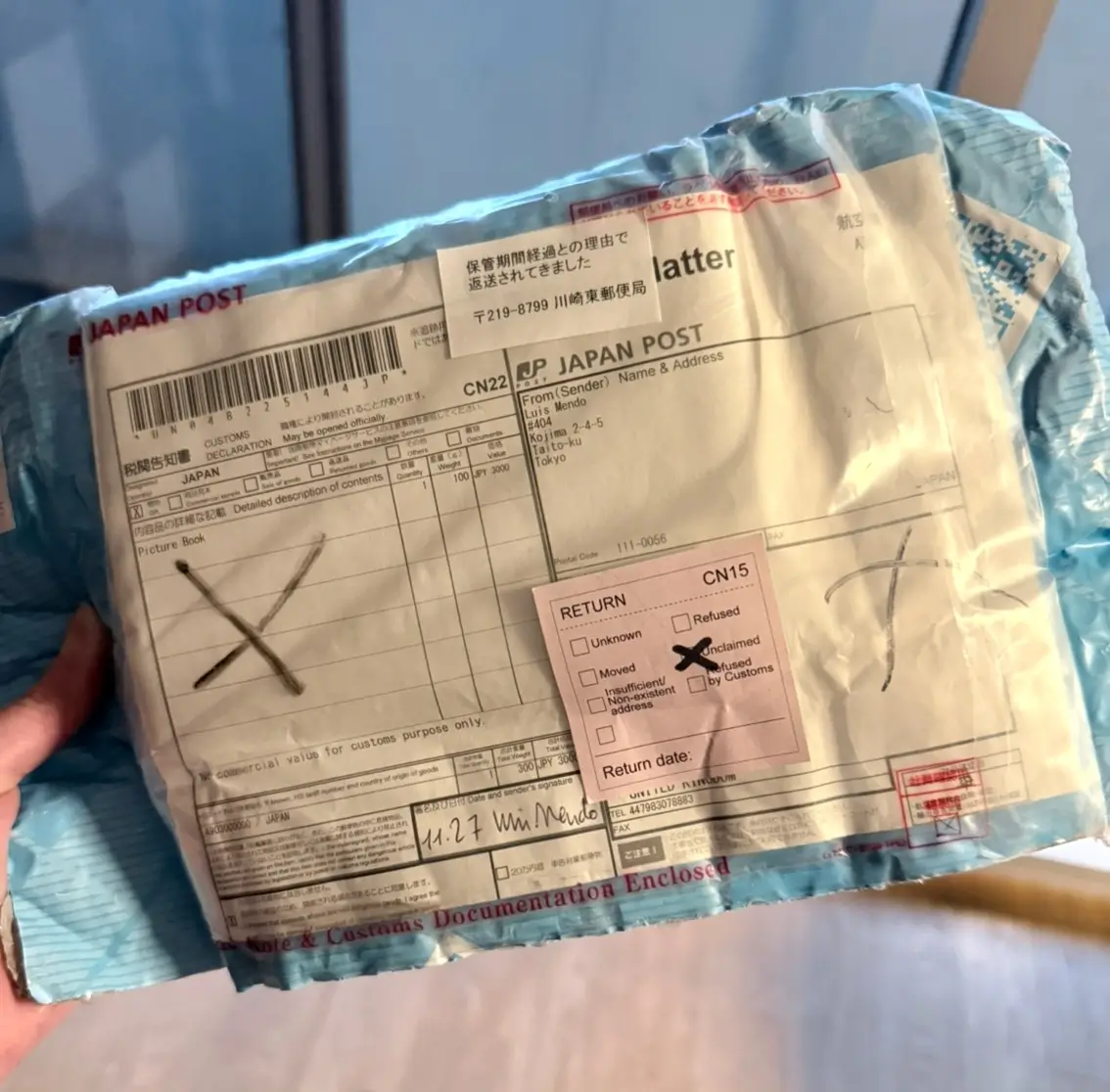
It’s CRAZY but I have received your book back in Japan this week! OMG. I sent it on the 27th of Nov and it came back as “Unclaimed” … I am sorry!
What shall I do? Send you a new one?
Wait, what?
It took me a moment to reorient myself as I ran a few searches in my email client. Then I found the order, but still it didn’t click.
Mundo Mendo, Book One. × 1
I resorted to old web searching, then found what I had ordered.
Luis had sent the book to my previous address in Gibraltar. I replied to his distressed email, giving him my Bath address — Apple Pay had my previous address when I made the purchase, which I had missed — and he promptly resent it.
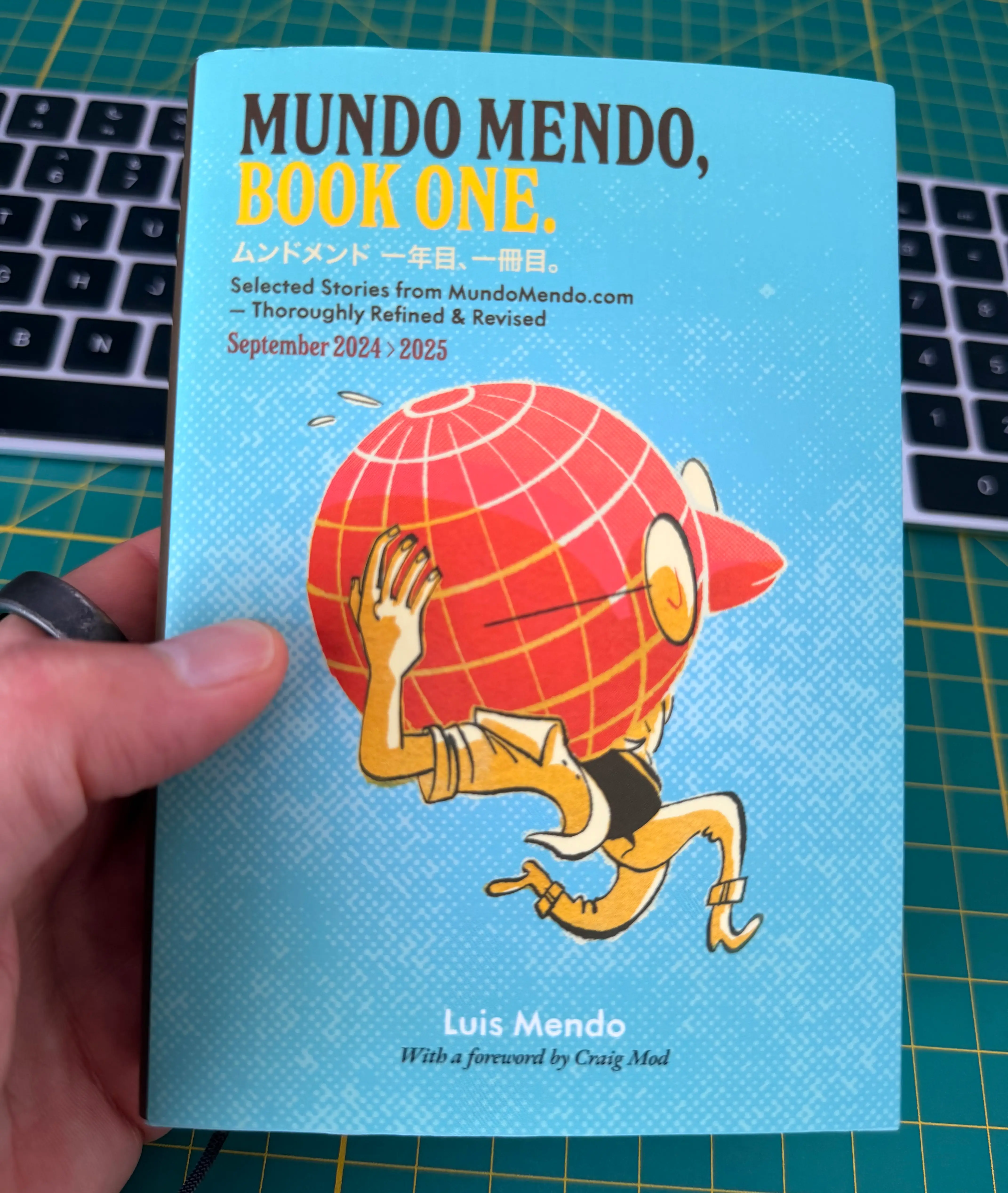
I received it a few weeks later, copy 0662 of 1000.
You may be wondering why the hell I’m sharing this with you, and that’s a good question.
It’s twofold, really, and both are worth reflecting on because it’s not only relevant to people like us — but likely how we’ll “survive” (and, for some, thrive) as creators in the following decade.
Firstly, Luis has created a World wrapped around his art. If you’re at all fascinated by visual storytelling through illustration, his websites will suck you in, as they did me.
As soon as I revisited luismendo.com and mundomendo.com, I realized why I made the book purchase in the first place. D’oh!
Yes, it was a signal of supporting his work, but, perhaps more importantly, it was a way of narrowing the gap, so to speak, getting closer — more personal — to his work.
Not just a beautiful bunkobon-sized (4.13×5.91 inches or A6) book, but also:
- Limited edition of 1000 copies
- Numbered and signed by the author
- 272 Pages full color offset
- Printed in Japan on FSC certified paper
- With a cute sewn-in bookmark ribbon
… and, imbued with the author’s personality right there on the page:
- Guaranteed smell of paper until you dip it in coffee
- Readable in bath tubs, beaches and pools alike
- No battery, no charging needed
- 2.5 cm thick, could be a pillow or used to raise your monitor
These are expressions of world-building — or, as I teach on the inside, one of the principles of TDW; Ethos, which emerges on the other side of intentional building.
None of this was a strategy, by the way.
Luis moved to Japan around 2014 on a sabbatical — recovering from burnout after a successful 20-year career as a creative director. He kept a daily illustrated diary. A friend saw the sketches, asked him to make magazine illustrations, and that quickly led to a Japanese agency and a full-time career switch.
He didn’t build a funnel. He made the work, kept making it, and a World formed around it. Ethos emerged; the audience assembled itself.
There’s no getting around the part luck plays in all of this, as it has for me, and no doubt, in your life, too.
But I’ve found, at least for me, that luck tends to reveal itself when we are most true to ourselves. We can’t plan for it, or bank on it showing up, but show up it will. So the simplest thing to do is to explore forward, driven by what matters to us — which is the work we do.
That work, which I’m of course viscerally drawn to, has a human at its center.
In the world obsessed with AI, there’s something special seeing a body of work that’s 100% AI free. Not because AI is bad, it’s not. But that some work doesn’t benefit from it.
Now, here’s the part we tend to skip past.
Everywhere we look — social, YouTube, the feeds — we’re shown the ones who made it. The creator who broke through. The coach who built a business from reels. The writer who turned a thread into a career. The YouTuber who escaped the office, moved to a tropical beach, and turned freedom into content.
The platforms don’t need to fabricate these. They only need to keep parading them, because the parade is what keeps the rest of us posting.
And the quiet lie inside the parade is that we could be next — that with the right hook, the right algorithm day, we’ll be pulled up into the head of the dragon too.
Maybe. But that’s a lottery ticket, not a strategy.
And here’s the part we don’t like to hear: we don’t get to build for big and small at once. The head and the long-tail are different games. You choose one.
Luis chose the tail.
So what do humans want, if not the lottery?
I’ve been circling this idea for a long while without quite having language for some of it. Then, in a recent conversation between Sam Harris and Vinod Khosla (co-founder of Sun Microsystems), Vinod put words to it better than I’d managed (from about 9 minutes in — emphasis mine):
If, in fact, we get large-scale job displacement, which I think is likely within a decade, and every corporation in America will be failing if they haven’t quadrupled their revenue per employee, or for a given amount of revenue, have one quarter the number of employees, there is another version…
So in that world, what do humans want? I think the key driver will not be utility. I can buy this coffee mug I have in my hand from China pretty cheap. It’ll be for human preference.
That means if it’s made by a human, I have provenance, I have a story attached to it, I’ll prefer it. So human preference may pay a large role, in which case we might end up, and I think the most likely scenario for 2035 is far, far fewer corporate jobs, but 50 million more micro-entrepreneurs in the US.
Let’s just take one geography. And these micro-entrepreneurs, because of AI, don’t have to know anything other than their skill. I grow the best flowers. I carve the best wood. I bake the best muffins. I’m best with dog walking. And humans will prefer that.
And so human preference, not utility, starts driving it because all utility is in a hugely deflationary economy going to zero. And so you have this human preference element, which will allow many more people to be their own boss, be a micro-entrepreneur, do the thing they love most.
I think that’s one and probably the most likely scenario. There’s other scenarios possible, but lower probability, I would guess.
This “human preference,” as Khosla puts it, becomes our human moat, the thing that’s not just desired, but sought out.
As micro-entrepreneurs, if we focus narrow enough, we get to create work that matters for people who care about it, and will (gladly) pay for access.
Here’s the strange part, which I’ll come back to: the same forces making the world enormous are also making it tiny.
Establishing a Tiny Digital World is, of course, one way in.
Just as Luis Mendo is building. For people like me. His 1,000 True Fans … or 2,000 … or 500 … whatever he has.
The number 1,000 isn’t a magical threshold. It’s simply pointing to the concept of small, tiny even — people who care, and who’ll pay with attention and money.
Khosla is describing the weather, so to speak — the macro tilt, why human preference becomes the thing people pay for. But weather is abstract until someone you recognize makes a choice inside it.
Tim Ferriss did, recently. In a post asking Has AI Already Killed How-To Nonfiction?, he landed somewhere I keep landing too:
So here’s where I’ve landed, at least for now:
I’d rather write books for 10,000 people than make short-form video clips for 10,000,000.
Adding a little more, I’d say:
I’d rather write books for 10,000 people who are genuinely changed by them than crank out short-form videos for 10 million people who forget about them within days or minutes.
Why?
… the market for information is collapsing into the chatbot. The market for transformation — for sitting with one mind, at length, on a subject it has bled for — might just get smaller, weirder, and more interesting. I’d bet on it. In a way, we’re reverting to the earlier days of the Internet.
1) Find your 1,000 True Fans. If you started off doing this well but have meandered, it’s time to revisit. Get very clear on who those 1,000 people are.
2) Surprise and delight them. Overdeliver again and again.
3) Success!
The paradox is that the world is becoming bigger and smaller all at once. The long-tail is where “human preference” opportunities are mined. The head is for celebrities and influencers with fans in the millions.
For everyone else, Tiny wins.
~André
P.S.
It’s not lost on me that, upon revisiting Luis’s World, I joined his yearly membership. These things work like that. Rarely does a conversion happen at first contact.
Think about it: resonance happened, a book was ordered … got lost, and I forgot about it, because, you know … life happens … a moment of reconnection six months later, the book arrives, I reorient — and join his membership.
There’s a beauty in that.
