Basecamp → The Principles → Paradox & Disorientation
“Before you can do anything else, you have to be properly orientated.” ~ Werner Stegmaier, What is Orientation?: A Philosophical Investigation (2019)
A Beginner’s Preface to Orientation
I discovered the ‘Philosophy of Orientation’ a few years ago when making my way through John Vervaeke’s 50-part lecture series on ‘Awakening from the Meaning Crisis‘ and, more recently, his series ‘After Socrates.’
In these lectures, whenever the topic of orientation is discussed, John credits Werner Stegmaier as the preeminent thinker, pointing to his seminal work ‘What is Orientation?: A Philosophical Investigation,’ which gave me fertile ground to explore even deeper.
The ‘Philosophy of Orientation’ explores how we find our way in complex environments, both physical and conceptual. This makes it particularly relevant to digital world-building, where we create navigable spaces and experiences for learning, growth, and connection.
It’s important to acknowledge that this topic is technical and complex. However, learning about it will give you an outsized edge because orientation affects all of us all of the time.
As someone with a beginner’s interest in cognitive science, I am admittedly still a novice learner in this domain and remain largely ignorant. However, even from my limited perspective, the discovery of the Philosophy of Orientation has had a transformative effect on me and how I perceive its role in digital world-building.
Over time, as I develop a more nuanced understanding of this philosophy, I will revise this lesson to reflect my improved perspective.
For now, I offer this introduction as a starting point for exploring how orientation principles can enhance our approach to creating more engaging digital worlds.
Finally, why, you may be wondering, am I revisiting a principle already covered earlier with wayfinding?
Well, “orientation” as a process by which individuals find their bearings in the world relative to various factors such as physical space, social context, and personal goals, pairs well with the principle of wayfinding, which is also a navigational device.
However, the real power and leverage come from understanding disorientation. An interesting dynamic is that orientation becomes especially noticeable when it is “troublesome” — when we encounter disorientation or a paradox, causing us to reevaluate our current understanding and framework.
In day-to-day life, when things are running smoothly, our orientation often operates in the background unconsciously. We navigate our environments, make decisions, and take actions without giving much thought to the process. Orientation, in these cases, is a seamless part of our experience and largely “invisible”.
For this reason, I wanted to dedicate an entire section to this dimension of orientation, drawing attention to how we, as World Builders, can engineer disorientation and encounters with paradox.
The implications of this will become clearer by the end of this final section of the training.
Summary
Orientation refers to the process by which individuals find their bearings in the world. It involves understanding one’s position relative to various factors such as physical space, social context, and personal goals.
Proper orientation allows for effective navigation through life, enabling purposeful action and decision-making.
The first thing to recognize is that “orientation” is primordial, meaning it precedes all definitions and propositions. We never experience the world, internally or externally, outside the experience of orientation.
Another interesting dimension of orientation is its recursive nature. Orientation always presupposes another orientation, and at the same time, orientation always follows prior orientations.
Said another way: Orientation is the beginning of everything without itself having a beginning.
This concept can be challenging to grasp initially, so I encourage you to reread it a few times.
As an orientation, it is always a new orientation or a ‘reorientation.’ Thus, it proceeds from itself and refers, at the same time, always to something else: the new situation.
As Stegmaier explains in his book, “We call it both ‘self-referential’ and ‘other-referential.'”
This investigation proceeds from the simple fact that one must already be oriented in everything one does, thinks, or says, in everyday life as well as in science and philosophy, and even when adopting orientations from others. To use a city map, one needs to be somewhat familiar with cities and city maps; to follow the instructions for a technical device, one needs to understand already something about technology and instruction manuals; to make good use of a piece of advice, one needs to be already well-advised about most other circumstances.
So as not to veer into the weeds, I’ll leave it there for now.
Earlier, I mentioned that orientation becomes especially noticeable when it is “troublesome” — when we encounter disorientation or a paradox, causing us to reevaluate our current understanding and framework.
I’ll demonstrate this shortly by concluding the story I started earlier about the 5.3K run I did in May 2023.
But before we get there, I want to paint the basic strokes of orientation and its dynamics for context, specifically in how we can use it as digital world builders.
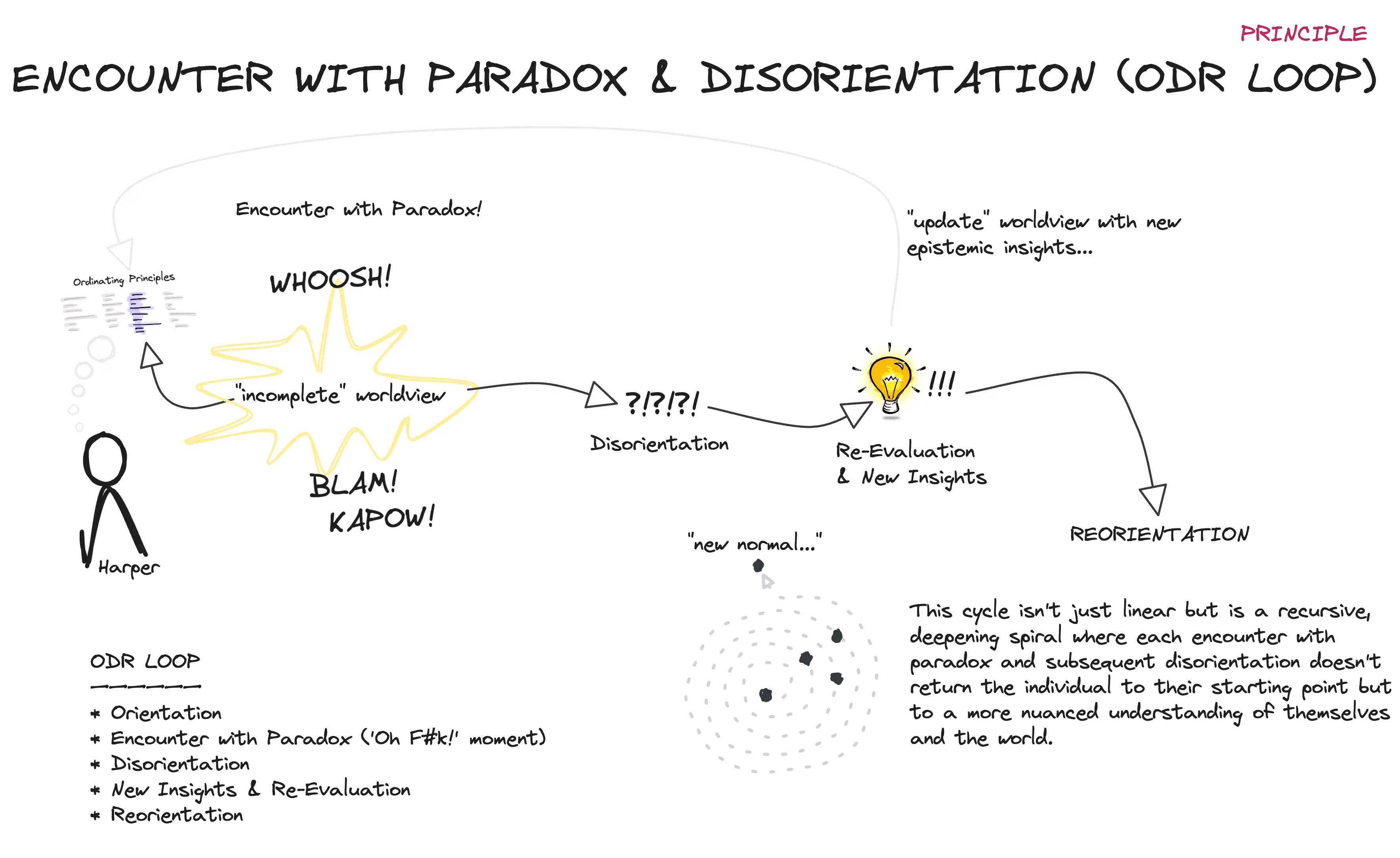
(Refer to the image at the top of this page.)
Harper, who is bound to their Ordinating Principles, value structure, worldview, needs, desires, and wants, lands on our website — in our World– for the first time.
This is a new situation. The “beginning” of orientation, but also following on from prior orientations.
Because we’ve already intentionally built our world to aid in initial orientation, Harper quickly feels at home, their salience landscape “foregrounding” points of interest. Click-click-clickety-click.
At this point, I need to fast-forward past Harper’s initial experience with our world to some point later…
In this example (of many possible variations), Harper navigates to an essay (notice that this individual article is never an isolated experience, but moments of orientation across a timeline), which causes them to experience a major moment of dissonance — an encounter with paradox, throwing their current worldview into question and sharper focus.
… a WTF!? moment.
Whoosh! Blam! KAPOW!
There’s an increase in entropy as the new information introduces ideas that don’t fit Harper’s existing frame. They feel confused and uneasy, like a mental “stirring,” creating a state where everything feels mixed up.
There’s a paradox of competing feelings — there’s disorientation, breaking Harper’s “frame” — and a moment of insight and aha! is triggered.
Magic!
As an orientation, it is always a new orientation or a ‘reorientation.’ Thus, it proceeds from itself and refers, at the same time, always to something else: the new situation.
Think of orientation as driving a car. As a driver, you constantly observe your surroundings and adjust your actions based on what you see. This is similar to how we continuously gather information and adjust our orientation in life. Just like driving requires continuous attention and adaptation to unpredictable and changing road conditions, orientation involves a constant process of navigating and making sense of an ever-changing world.
Proper orientation involves a deep engagement with our immediate experience and surroundings.
Successful orientation is often taken for granted until it fails, prompting reflection and problematization.
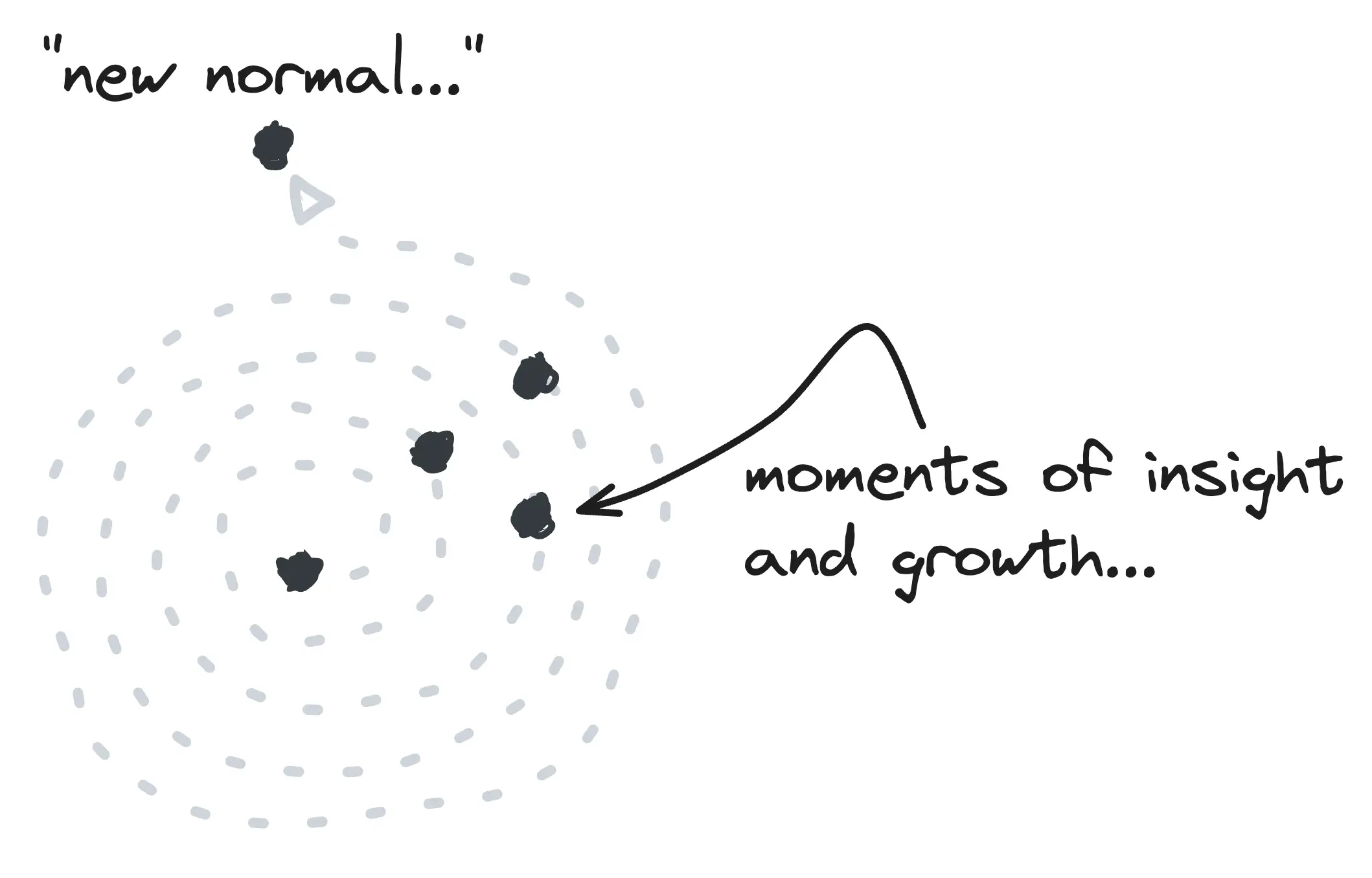
Here, Harper doesn’t return to their starting point or prior orientation of the world but a more nuanced understanding of themselves and the world.
Insights are experiences within the phenomenology of orientation.
Orientation is a continuous process of navigating through life, much like the ‘driving a car’ analogy. Insights are the moments of sudden clarity that help us reframe and adjust our understanding, much like finding a better route while driving. Both involve dealing with uncertainty and adapting to changing conditions.
Said plainly: Orientation is the achievement of finding one’s way in a situation under uncertainty and time pressure in order to make out opportunities for action to master the situation.