Basecamp → The Principles → CYOA → Patterns
The pattern of CYOA emerged in my internet writing quite organically sometime in the mid-noughties. It felt intuitive. It inspired how I created the ‘Soap Opera Series’ (SOS) from Autoresponder Madness and Art of Email and ‘multi-page presell sites’ (MPPS), which I taught in Sphere of Influence (SOI) years later.
One of my traits — it’s unclear to me whether it’s a feature or a bug — is that I intuit things (see patterns) and act on these intuitions unbidden, all without feeling any need for understanding to show up to the party, content with it catching up at some point.
I don’t seem to need to understand the “why” behind an intuition, before I venture forth, propelled by curiosity, into the dark forest with a skip in my step and a determined twinkle in my eye.
I’ve come to recognize and appreciate that my approach differs from intellectuals who excel at rapid comprehension of complex ideas.
I’ve discovered that my strength is in its “slowness”– relying on intuition and seeing patterns in the signal. I’ve come to appreciate this process.
Reflecting on the experiences that shaped my approach to CYOA, I believe sharing some pivotal moments will frame it within the larger context of this interconnected system.
This will provide you with a richer, more nuanced understanding of its application in this training.
§
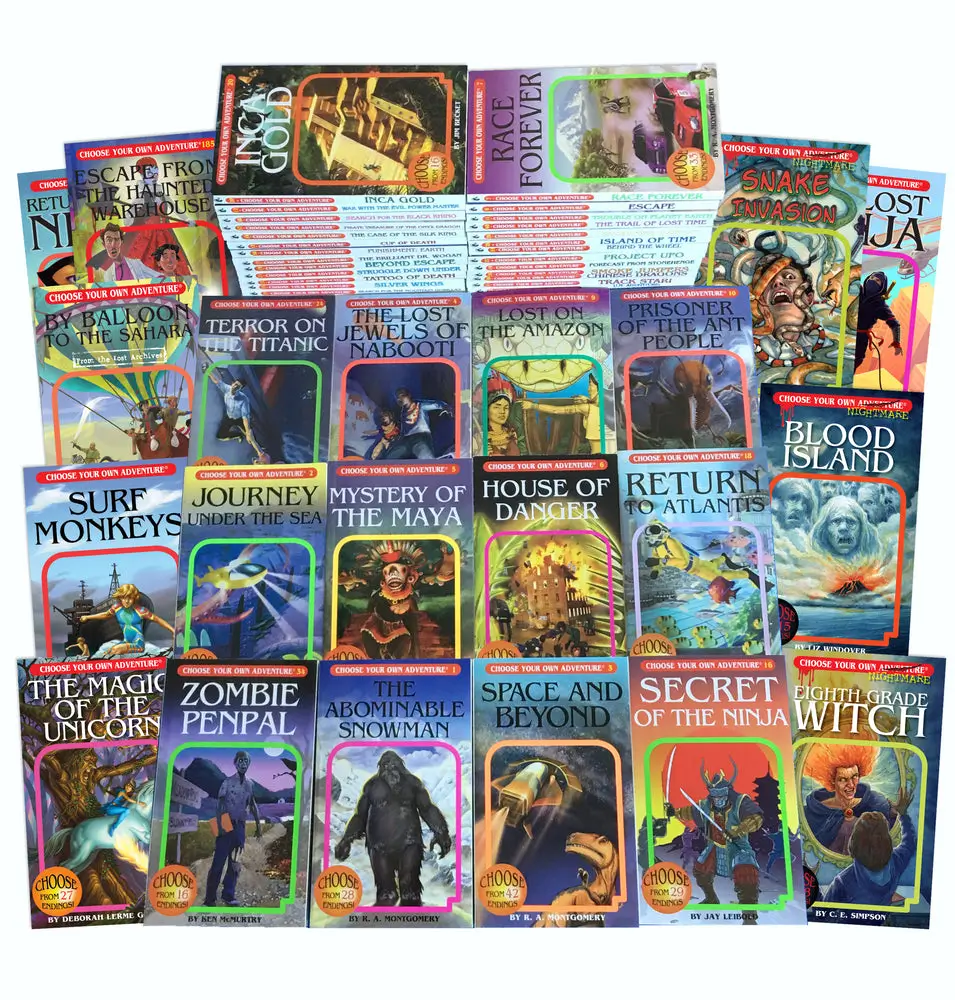
As a kid, I loved the Choose Your Own Adventure (CYOA) books, a series by Edward Packard (originally published by Raymond Almiran Montgomery, who died in 2014 at the age of 78) featuring stories written in the second-person perspective.
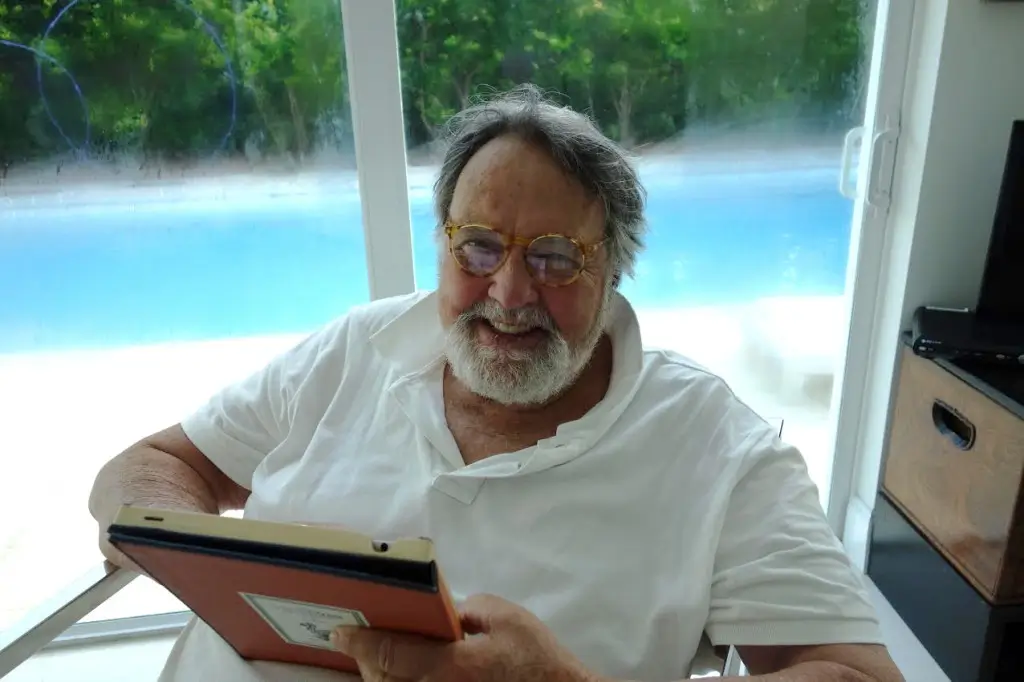
In many circles, Montgomery is credited with spawning a genre that has impacted countless other industries. Role-playing video games like Dungeons and Dragons, for instance, are rooted in the “you”-centric narratives that CYOA books popularized.
As I mentioned earlier, the second-person perspective is a point of view in storytelling, narration, or communication that primarily uses pronouns like “you” and “your” to address the reader directly (“Imagine you’re standing in front of a room full of people, about to give a speech. Your heart races, your palms sweat, and you feel a knot in your stomach…”). This perspective creates a more interactive and transformative experience, involving the reader in the narrative.
In these books, the reader takes on the role of the protagonist and makes decisions that influence the character’s actions and the story’s outcome.
Just think about how intoxicating that small but significant change in dynamic is for a reader. It shifts agency to them, inviting them to be part of the unfolding adventure.
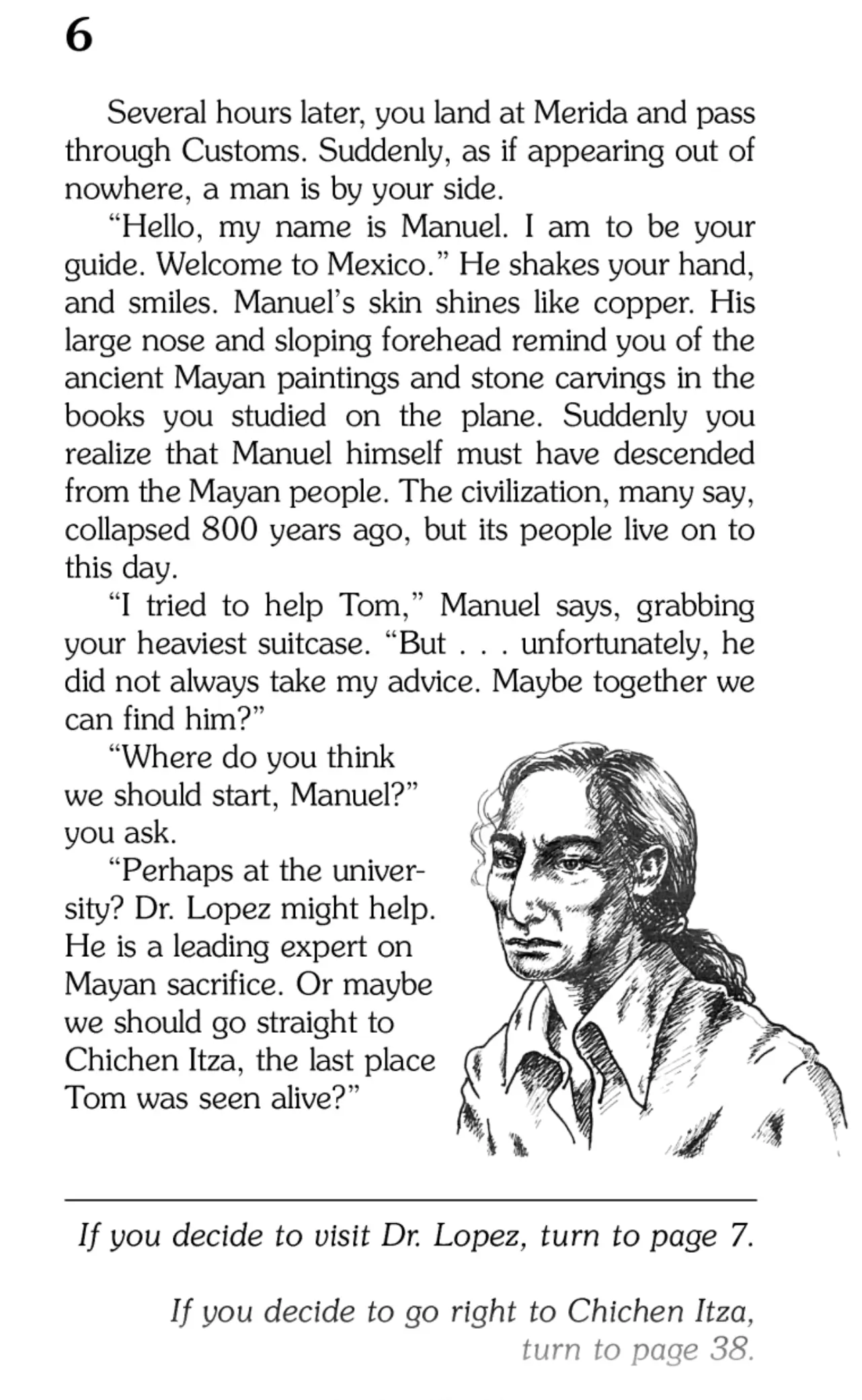
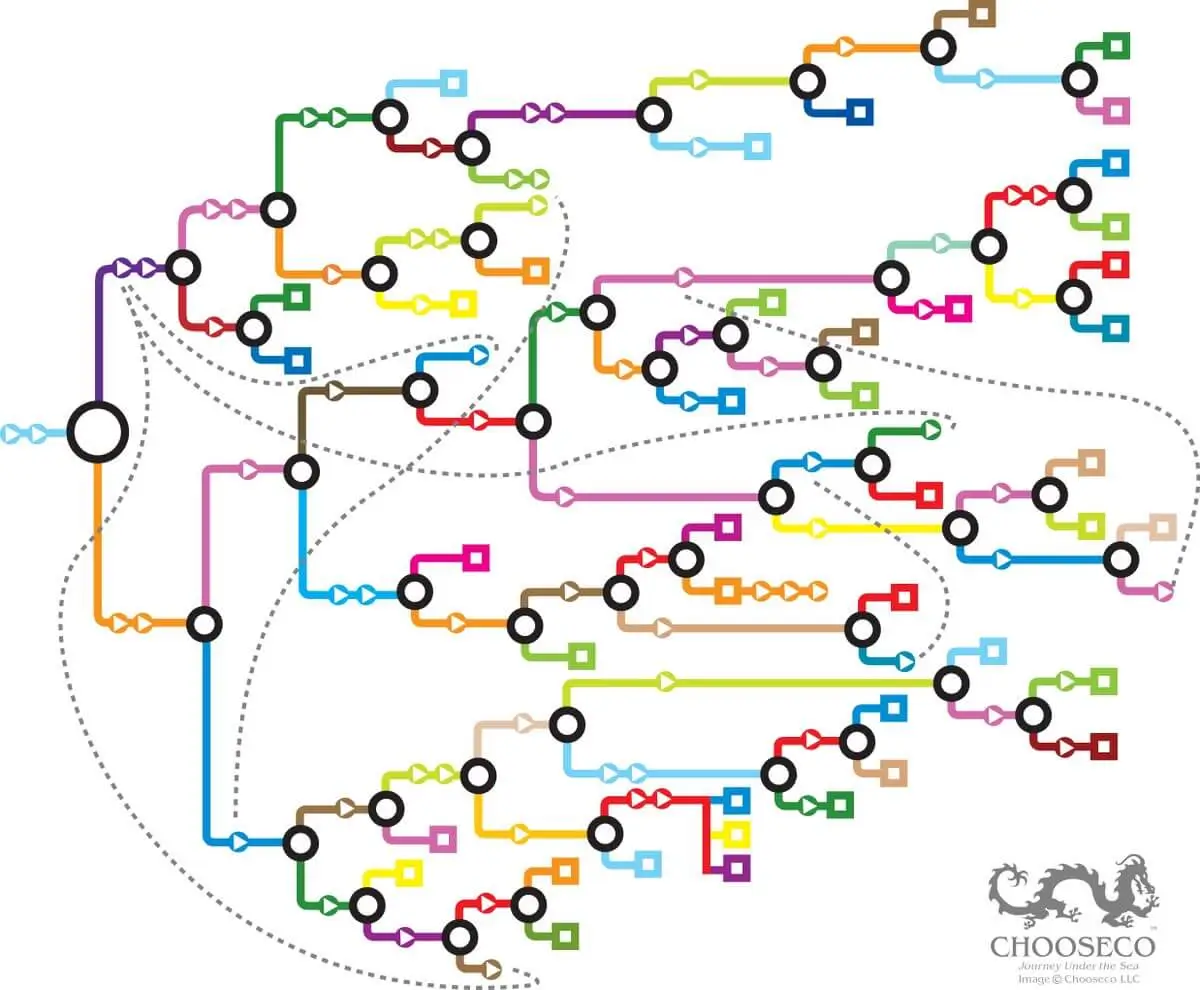
These books (270 million copies sold!) created ‘worlds,’ each allowing the reader to “write their own story” by making nearly two dozen choices that could lead to around 42 possible endings.
These books appeared “to be as contagious as chicken pox,” said an article published in 1981 by The New York Times.
This non-linear storytelling experience, inspired by the CYOA books, points to another way of imagining how we can create transformative customer-led experiences within our open-world marketing and worlds.
§
I used Montgomery’s CYOA books not as a model for open-world marketing but as inspiration. It contributed to the sense-making pattern evolving in my head.
However, Montgomery’s CYOA books aren’t a good analog for digital world-building for a number of reasons.
We (mostly) don’t write in the second-person perspective, at least not entirely. We also don’t write narrative-nonfiction over a series of pages with different endings. It’s been tried before and failed.
However, publishing on the internet has a superpower that written narratives don’t: a universe made up of hypertext and hyperlinks.
Coined by Theodore Nelson, a pioneer in the computer industry in the 1960s, the term hypertext describes “non-sequential writing — text that branches and allows choices to the reader, best read at an interactive screen.”
The major difference between CYOA-inspired books and CYOA-inspired open-world marketing is that in the former, the branching stories are already written, each leading to a conclusion.
Every reader who chooses an “ending branch” will terminate in the same exact way — tragedy! Or, with some luck, reach an ending that results in success for you, the hero. Yay!
But we don’t write short fiction with branching endings.
Many years ago, I became interested (obsessed to a degree is probably more accurate) in a form of hypertext known as “Hypertext Literature,” which is also referred to as “Hypertext Narrative” and “Hypertext Fiction.”
Hypertext fiction is a genre of electronic literature, characterized by the use of hypertext links that provide a new context for non-linearity in literature and reader interaction. The reader typically chooses links to move from one node of text to the next, and in this fashion arranges a story from a deeper pool of potential stories. Its spirit can also be seen in interactive fiction.
In a 2013 WIRED article, the author, Steven Johnson, says this:
It’s not that hypertext went on to become less interesting than its literary advocates imagined in those early days. Rather, a whole different set of new forms arose in its place: blogs, social networks, crowd-edited encyclopedias. Readers did end up exploring an idea or news event by following links between small blocks of text; it’s just that the blocks of text turned out to be written by different authors, publishing on different sites.
Someone tweets a link to a news article, which links to a blog commentary, which links to a Wikipedia entry. Each landing point along that itinerary is a linear piece, designed to be read from start to finish. But the constellation they form is something else. Hypertext turned out to be a brilliant medium for bundling a collection of linear stories or arguments written by different people.
(Emphasis is mine.)
These insights more broadly contributed to the pattern of how I thought about CYOA.
“Hypertext Narrative” felt more and more like a better way to write essays, articles, emails, and multi-page narratives, where, contextually, I would link to related ideas (internally or externally), creating an interlinked branching experience.
The branches weren’t about “endings” (tragedy or success like with the books) but affording a more interactive experience where customer-led narratives could emerge off the page.
§
A few years ago, I listened to an interview with Alex McDowell, the creative director hired by Steven Spielberg in 1999 for the movie The Minority Report (released in 2002).
The Minority Report is a 1956 science fiction novella by American writer Philip K. Dick. However, for the screenplay adaption, no script had been written.
Spielberg wanted to do something different. He wanted to avoid this being a science fiction movie like the novella, but rather a future reality viewers could immediately relate to.
Alex McDowell got just a few “rules” from Spielberg (from a half-page synopsis):
- Location: Washington DC
- Year: 2054
- Disruption in the center: PreCogs
From this, Alex McDowell and his team were tasked with designing a “world” without a script.
When listening to McDowell, I was struck by his statement that the design of the world preceded the telling of the story: “The world became the container for narratives…”
We could have told hundreds of stories in this space,” said Alex McDowell. “We knew the world intimately. If Steven Spielberg had wanted Tom Cruise to turn left instead of right out of any doorway, we knew what was there. And it was clear that you could apply completely different lenses to the world developed for the film.
Although our work supported a linear cinematic narrative, it could also have been used as a way of looking into the future of urban planning; targeted advertising; wearables; gesture-based interfaces; autonomous mobility, many diverse aspects of the world.
A kind of real-time, nonlinear process evolved throughout the production of this film, which tested not only how one might think differently about film production, but also how to think differently about developing a story. For the first time there were digital sets and design visualization allowing the director’s interaction with the film environment and digital characters long before shooting.
What was also significant was that scenes emerged from the development of the world that would not have been in a script written in advance of production by a writer sitting in a bungalow in the Hollywood Hills and typing out 120 pages. The world had incepted the narrative in a really fundamental way. The fabric of the world had triggered the story.
~ Alex McDowell, World Building (FoST), 2016 Future of StoryTelling Summit
§
As the architect and engineer of our own Tiny Digital Worlds, we get to do something similar insofar as the world we build becomes a “container” for the narratives Harper experiences, both on the page (in the world) and off the page (contributing to and shaping Harper’s internal narrative and worldview).
The following principle, Invisible Conversations, unpacks this further, but for now, it is critically important to recognize that all of this starts with an experience on the page.
§
For a long time, I’ve been saying that we’re in the insights business, the aha! business. By using the principles of TDW, and specifically CYOA (and Invisible Conversations), we create the affordance for insights and aha! moments…
We leave “easter eggs” for some people to find (this training is littered with many)…
We present rabbit holes, opportunities for exploration and learning…
All this is to say, our TDW becomes a container for narratives and insights.
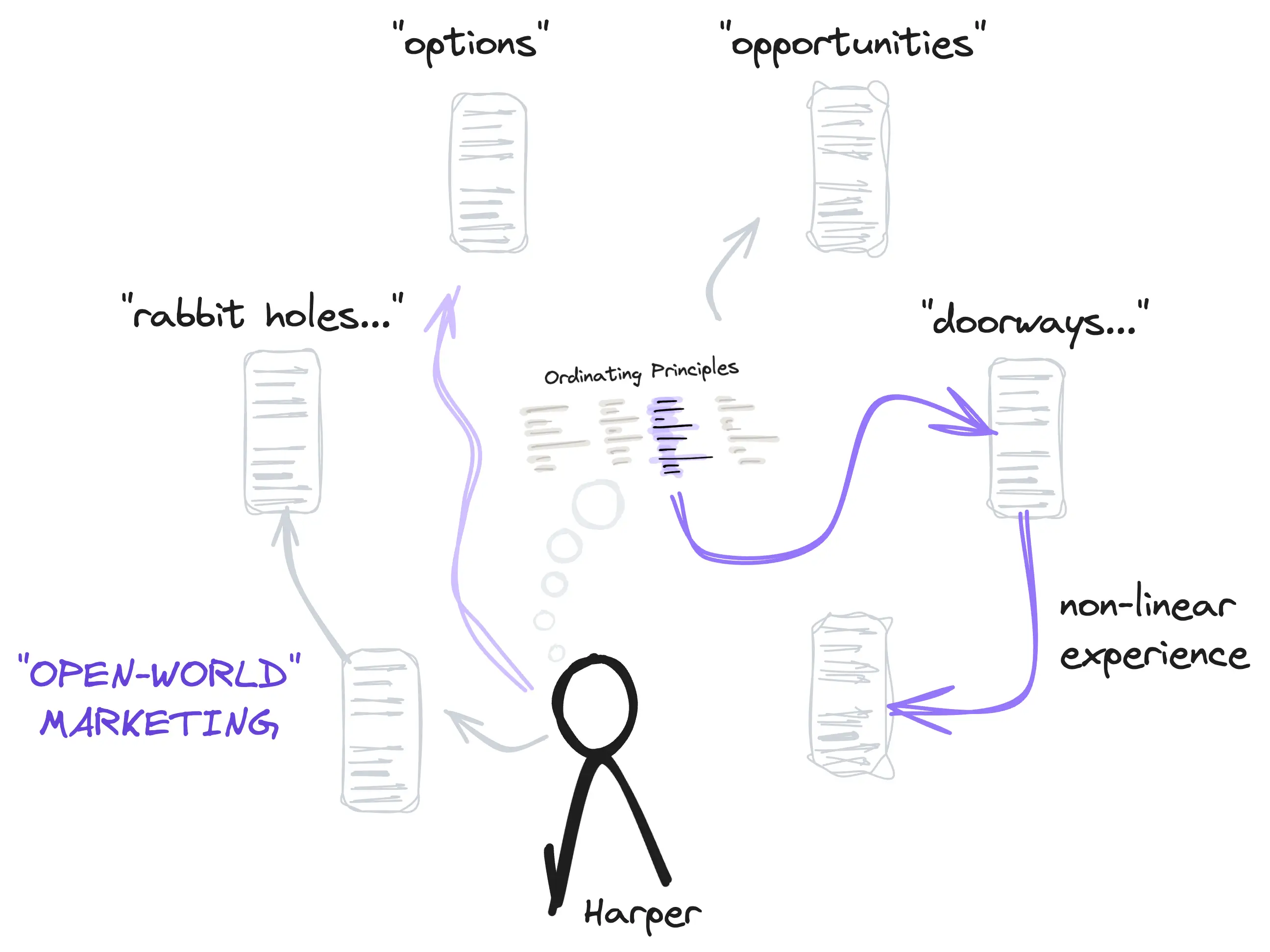
While I intuited that creating the affordance for Harper to experience “insights” and CYOA, along with the other principles of TDW, created this affordance, the mechanism remained a mystery to me until more recently.
In his 50-part lecture series, Awakening to The Meaning Crisis, John Vervaeke discusses Relevance Realization, one of his most important foundational concepts.
Relevance Realization is the process by which we determine what is important in any situation (salience). It involves:
- Ignoring numerous, less useful options (backgrounding).
- Focusing on a few potentially valuable ones (foregrounding).
According to John Vervaeke, this process is the overarching meta-goal of existence. It involves constantly adapting and responding to our environment by balancing between stability (order) and change (chaos).
John Vervaeke on Relevance Realization (Deconstructing Yourself, October 5, 2022)
This process of determining relevance is essential, not just for learning new skills, but for navigating life’s complexities effectively.
I’m going to keep the following section light…
For one, it’s technical, and I’m woefully ignorant of the fields of study in which Vervaeke (and Brett Andersen, whom I’ll introduce next) are schooled.
However, thankfully, diving deep into cognitive science isn’t a requirement for appreciating and leveraging the nuances at play.
Every time I listen to Vervaeke (and other academic scholars in his orbit), I recognize the shallowness of my knowledge in this area. Yet, each time I expose myself to their thinking, I feel I capture a little piece of the larger puzzle.
Anyhoo…
In 2022, Brett Andersen, an evolutionary psychology PhD student at the University of New Mexico, wrote a truly mind-bending essay titled Intimations of a New Worldview.
I intercepted the essay when listening to an interview between Brett and John Vervaeke.
Our ability to realize relevance is largely determined by our ability to properly formulate problems and to re-formulate them when necessary. This is the role of insight. We formulate problems by framing them in particular ways. This frame constrains the kind of solutions that seem viable to us. When we have an insight we break our current frame and adopt a new frame. The new frame allows us to reformulate the problem in such a way that better solutions become viable to us.
While most of their discussion floated far above my understanding, one concept jumped out as incredibly salient.
I was in the lobby bar of one of our hotels here in Gibraltar, The Eliot, with my little notebook, pencil, and pint of beer (I will add it was a Saturday afternoon). I scribbled down an image capturing the process Brett articulated to John V, which I’ve redrawn below:
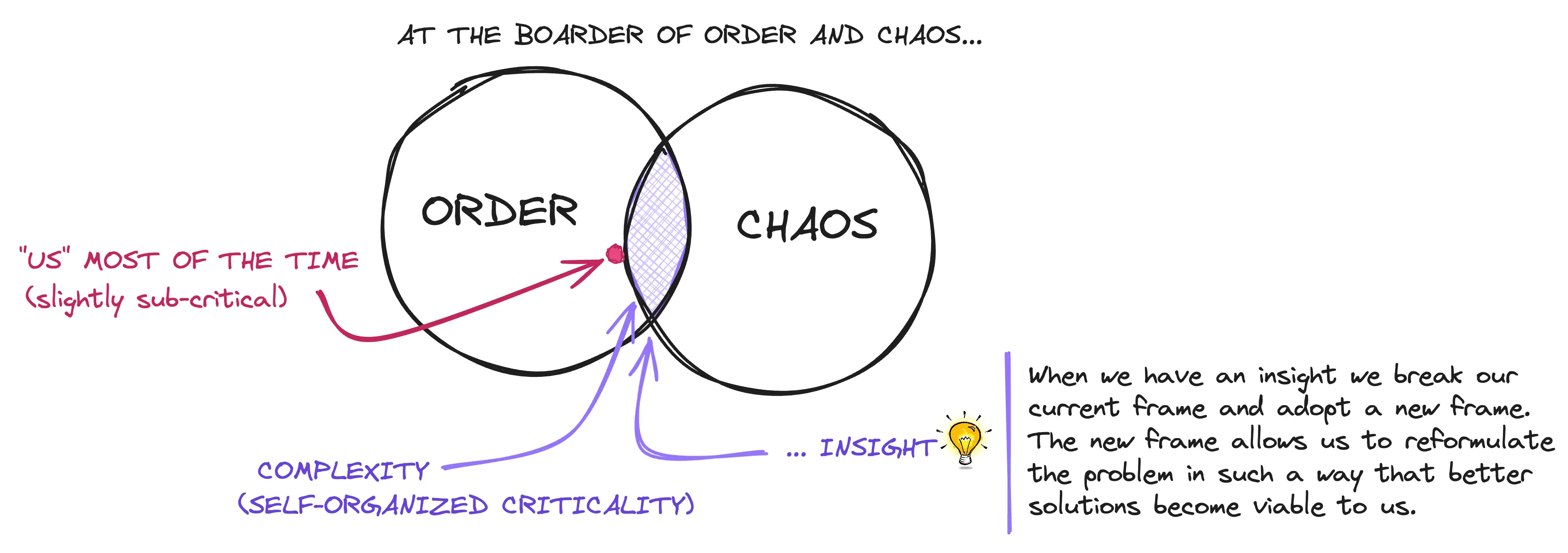
Note: The red dot signifies that most people’s brains typically operate in a slightly sub-critical state, indicating that we are usually not perfectly balanced at the edge of chaos but tend slightly towards order.
Brett Andersen’s arguments around the border of order and chaos, where complexity emerges, and insights occur, revolve around the concept of criticality in complex systems (reasoning informed by physicist Per Bak years earlier).
Self-organized criticality is a pivotal concept in understanding how complex systems naturally evolve to a critical state where they are balanced between order and chaos.
This is a state where the system is neither too rigid (overly ordered) nor too erratic (chaotic) but instead is optimally poised to perform complex computations and respond to inputs effectively.
Systems at criticality achieve the highest level of computational capability. Ordered systems are too rigid and erase changes quickly, while chaotic systems are too erratic to provide reliable responses.
Critical systems balance these extremes, enabling effective information transmission and storage.
The border between order and chaos is described as the “optimal state” for both psychological well-being and biological function. This optimality is reflected in the ability to achieve relevance realization and engage in non-zero-sum games.
The part that jumped out at me as salient is that insights emerge at the border of order and chaos. This involves disrupting habitual patterns (fixed-point attractors) and exploring uncertain environments ripe for learning and adaptation.
Bingo!
From a phenomenological perspective, the process of standing at the border between order and chaos involves a continuous interplay between stability and change, order and novelty. This dynamic balance is essential for the emergence of new patterns and insights.
The Process of Having an Insight
(I’ll use a second-person perspective to pull you into the narrative.)
Here’s an example of what happens when you are exposed to an interesting article that you’ve identified as salient, capturing your attention.
John Vervaeke on Insights (Deconstructing Yourself, October 5, 2022)
This process occurs between the principles of CYOA and Invisible Conversations. Later, I’ll also cover the Encounter with Paradox, which describes the tension between Orientation, Disorientation, and Reorientation.
- Encountering New Information:
- Current Frame: Initially, you approach a new article with your existing knowledge and beliefs. This is your current frame where everything makes sense in a certain way.
- Sorting the Input (Relevance Realization): Relevance realization kicks in here, helping you focus on critical pieces of new information that might challenge your current understanding, filtering out less relevant details.
- Breaking the Frame:
- Increase in Entropy: As the new information introduces ideas that don’t fit your existing frame, you feel confused and uneasy. This is like a mental “stirring,” creating a state of increased entropy where everything feels mixed up.
- Highlighting the Conflict (Relevance Realization): Relevance realization helps highlight the conflicting information, causing the mental chaos needed for you to reassess your current beliefs.
- The Moment of Insight:
- New Understanding (Insight): Amidst the chaos, you suddenly experience an “aha!” moment. This is when the relevant pieces of information align in a way that makes sense, breaking through the confusion. This is the moment of insight, where your brain establishes a new frame that incorporates the new ideas.
- Connecting the Dots (Relevance Realization): During this moment, relevance realization assists in making new connections between the new and old information, leading to a clear and valuable insight.
- Returning to a Slightly Sub-Critical State:
- Improved Frame: After the insight, you return to a more stable and comfortable state. However, this time your understanding is improved and refined by the new insight, bringing you back to a slightly sub-critical state where your worldview is stable but enhanced.
- New, Improved Frame (Relevance Realization): Relevance realization continues to help integrate this new understanding into your daily thinking, updating your mental framework for future situations.
Relevance Realization is crucial throughout this process, guiding your attention to what matters most, helping you navigate through the confusion, and facilitating the emergence of valuable insights.
This dynamic balance between order and chaos, stability and change, is where true learning and growth happen.
TDW is a framework of principles that affords these transformative experiences.