Basecamp → The Principles → CYOA → Zelda
The Nintendo game I shared earlier, Zelda: Breath of the Wild, is a useful metaphor for understanding these principles, even if you’ve never played it.
Earlier, we learned about Orientation and Wayfinding and how we can draw attention to important “landmarks” within the world using website links and navigation, highlighting assets like a Manifesto or something similar, Values and About pages, and perhaps a “shortcut” to the Gates of Rome, quickly orienting Harper.
These are akin to the obvious landmarks represented as Sheikah Towers in Zelda: Breath of the Wild (see the video I shared earlier).
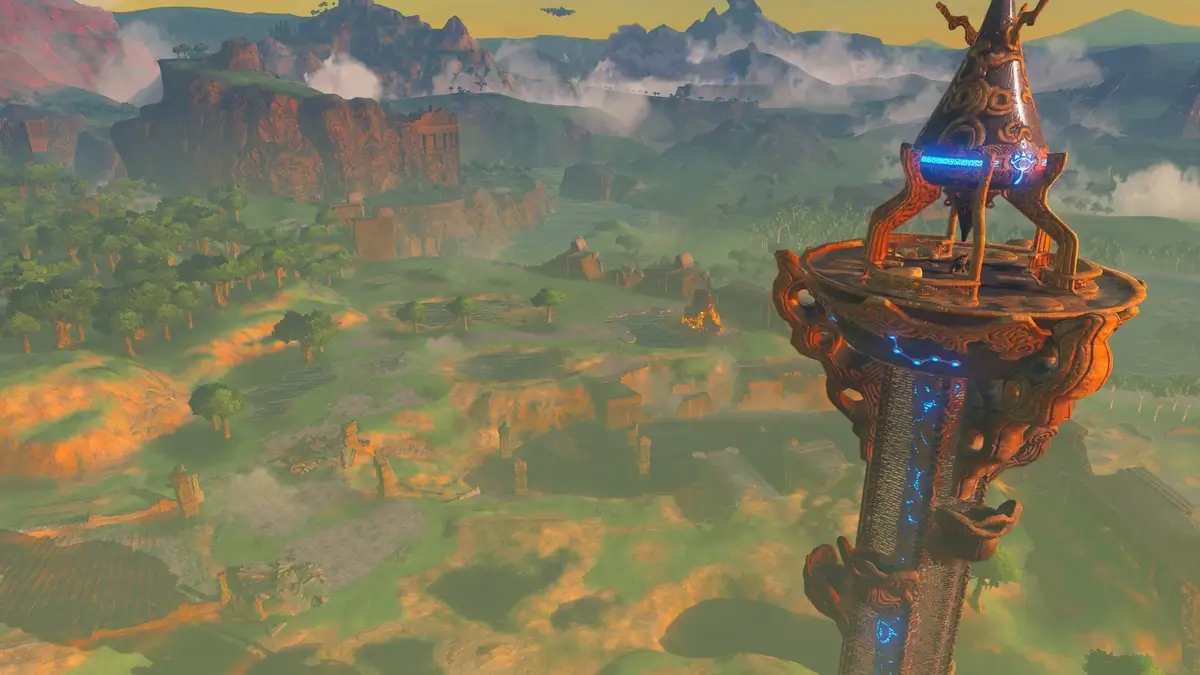
While these obvious landmarks aid in orientation, they also point the way to less obvious, smaller points of interest — for example, an essay series. Or a hub article, which forms the framing for yet other points of interest. These “rabbit holes” allow Harper to have a deeper experience, potentially encountering paradoxes and inciting insights.
Shrines (with a distinctive lit-up look) provide opportunities to increase your player’s health or stamina, encampments (which give off a tall tower of smoke) provide opportunities to find weapons, enemy bases (massive skull-shaped rocks) opportunities to find loot, and NPCs (non-player character), hand out rumors and side-quests.
These all contribute to a constant source of surprise and curiosity, providing an infinite loop of possibilities, driving engagement.
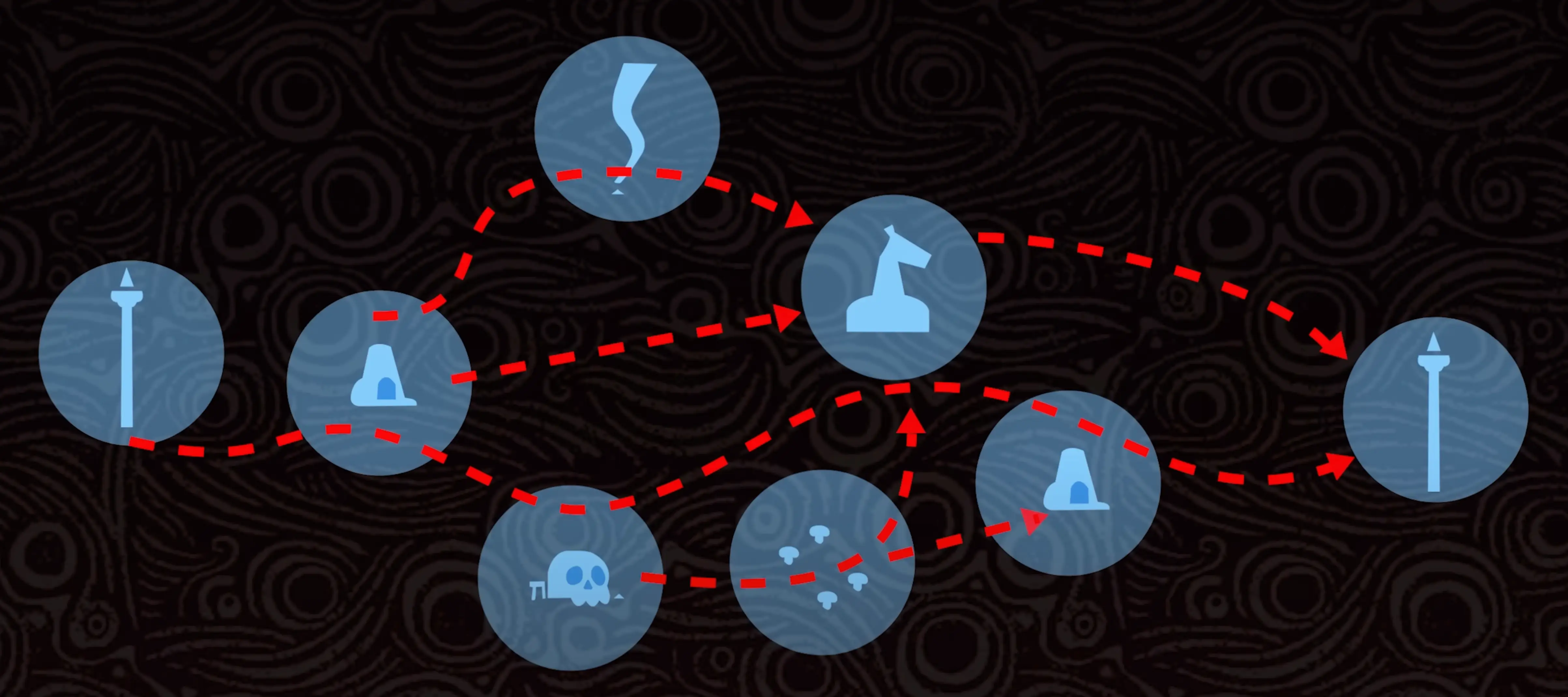
The game mechanics in Zelda: Breath of the Wild offers a model we can learn from — or, at the very least, a metaphor to more easily convey ideas that can feel complex and abstract at times.
The principle of CYOA is embodied throughout the digital world we build. Orientation and Wayfinding are expressions of CYOA.
Presenting contextual links in essays and articles is also an expression of CYOA, as is a blog page with all its links and decision points leading to places (knowledge) yet unknown. Or links within an email pointing back into the world or externally.
However, it’s when we look closer at the metaphor, modeled through Zelda: Breath of the Wild, that we get to see powerful nuances, details that are significant.
Yes, CYOA is about agency.
But bound up in agency and CYOA is the embodiment of possibilities.
Like an insight.
Where Harper breaks their current frame and adopts a new frame, allowing them to reformulate the problem in such a way that better solutions become viable to them.
That’s an act of service!
The principles of TDW are the engine for insights — encountering paradoxes, experiencing disorientation (increase in entropy by exposing ourselves to uncertainty at the optimal dose), re-evaluation, and new insights.