I got my digital crayons out for this issue to help visualize the pattern beneath something I’ve been circling for a while now.
This essay will give this image language, nuance, and higher resolution.
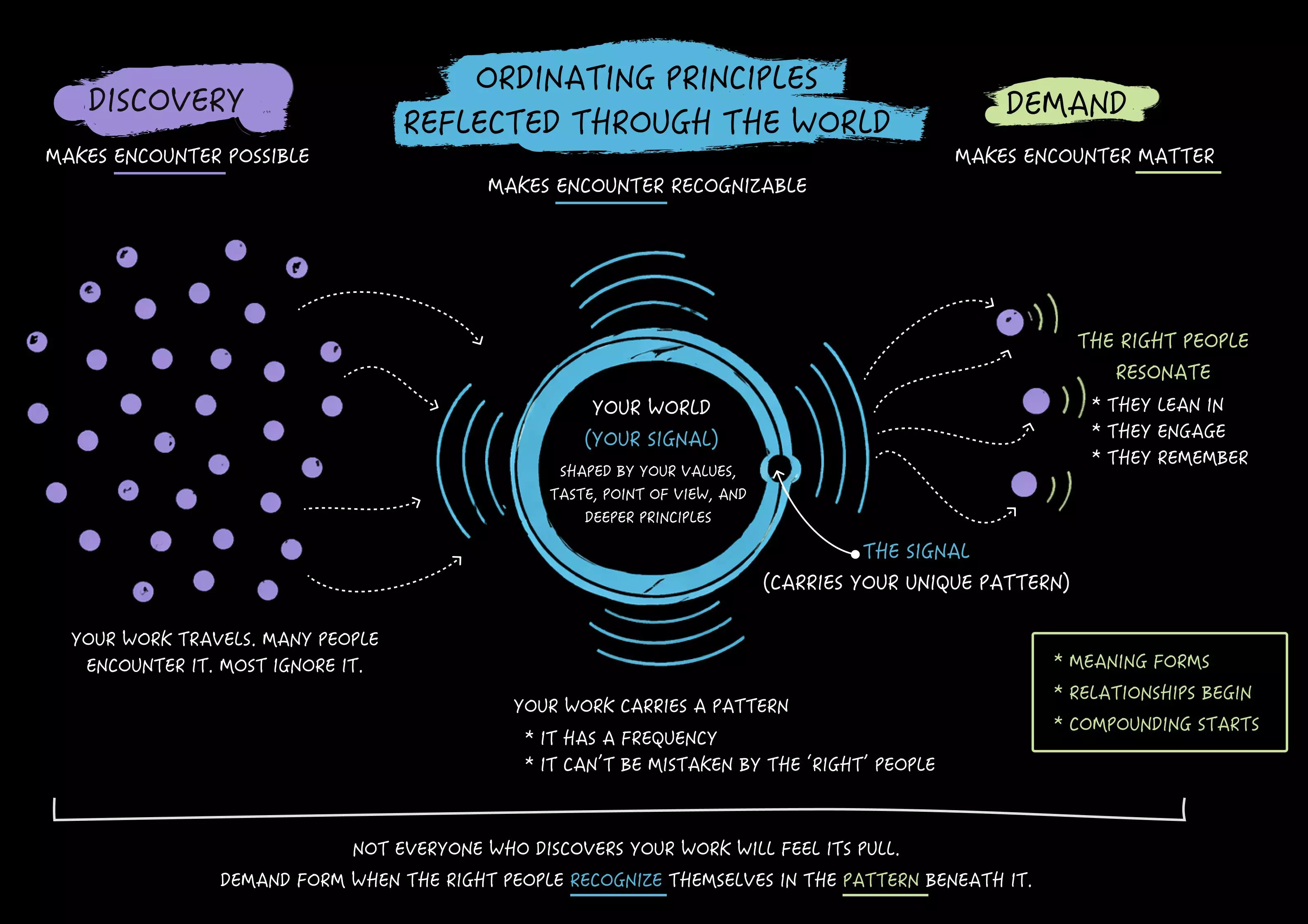
Enjoy!
As I said, there’s a distinction I’ve been circling for a while now.
One of those quiet distinctions that, once it sharpens into view, changes the shape of the whole landscape around it.
Something you can’t unsee once internalized.
It sits between two related ideas that are often collapsed into one:
Discovery and Demand.
They are connected.
But they are not the same thing.
And when we treat them as if they are, we end up confusing visibility with pull, exposure with resonance, and attention with consequence.
Discovery solves one problem.
Demand solves another.
Discovery makes encounter possible.
Demand makes that encounter matter.
That, to me, is the heart of it.
Because being found is not the same as being wanted.
A person can discover your work and feel nothing.
They can read the essay, skim the homepage, glance at the about page, and move on unchanged.
That happens all the time.
It’s awareness without consequence.
Exposure without pull.
A brush with the work that fails to create any real tension, curiosity, identification, or desire to step closer.
And yet, many creators remain fixated on discovery as if it were the whole game.
Understandably so.
Discovery is visible.
It is legible.
You can point to it.
Traffic.
Views.
Reach.
Followers.
Search terms.
Referrals.
Mentions.
These things are easy to discuss because they are easy to measure.
Demand is different.
Demand is subtler.
It often forms in the messy middle.
It looks like a person returning without being asked.
It looks like a line being remembered three days later.
It looks like someone forwarding your email to a friend.
It looks like a reply that says, “I’ve been thinking about this all week.”
It looks like someone quietly reading for months before finally stepping through the gate.
That sort of thing is harder to see.
Harder to track.
Harder to reduce to a dashboard.
But it matters more.
Because discovery can put your work in front of people.
Demand is what causes the right people to care.
And the overlap between those two is where something much more interesting begins to happen.
Not when more people see the work.
But when the right people encounter it and feel its pull.
That overlap is not random.
It does not happen merely because the topic is relevant.
Nor because the work has been polished into broad accessibility for the largest possible audience.
It happens when the work itself is charged with enough specificity, taste, principle, and shape that the right people can recognize themselves in it.
That is the deeper layer.
And this is where I think many creators go astray.
They assume discovery is mostly a distribution problem.
How do I get in front of more people?
How do I improve awareness?
How do I increase reach?
How do I get the algorithm to notice me?
Those are not illegitimate questions.
But they are incomplete.
Because discovery is not only about getting in front of people.
It is also about becoming legible to the right people.
That is a different project entirely.
In a Tiny Digital World-inspired expression of business, we do not “target” people in the conventional sense.
We are not cherry-picking people by observable traits.
Not demographics.
Not psychographics.
We are not reverse-engineering a message from market research and then spraying it at the internet in the hope of getting a response.
We are not trying to build a net that catches the most fish.
Rather, we embed our deeper preferences, values, worldview, and felt sense of what matters into the work itself.
Into the essays.
Into the emails.
Into the tone.
Into the structure.
Into the architecture of the world.
In other words, the work carries a pattern.
A signature.
A frequency.
And it is this deeper pattern — not just the overt topic — that allows the right people to recognize it.
That, in Tiny Digital Worlds language, is the role of Ordinating Principles.
They are the layer beneath the topic.
The deeper logic beneath the words.
The pattern that quietly repeats across the World you are building — reflected in your preferences, your standards, your taste, your tensions, your sense of what is true, what is ugly, what is beautiful, what is worth resisting, what is worth building instead.
This is why two creators can write about the same broad topic and attract very different people.
On the surface, they occupy the same category.
But beneath the topic, the signal is different.
And people don’t only respond to topic.
They respond to pattern.
That is the distinction.
The right people are not found merely because they match the topic.
They are found because they resonate with the pattern beneath the topic.
That helps explain why some work spreads widely but leaves little residue.
And why other work, even with less reach, creates a strange kind of gravity.
The first may succeed at discovery.
The second creates demand — or at least the conditions from which demand becomes more likely.
I was reminded of this while thinking again about Henrik Karlsson’s essay Search Query, which I first read in 2023 (and has lingered in my thoughts since).
What stayed with me wasn’t merely the metaphor, though it’s a good one.
It’s the implication behind it.
The point is not simply to publish something lots of people can find.
The point is to shape the signal in such a way that the right people can recognize it.
Not everyone.
Your people.
The ones for whom the work feels strangely charged.
The ones who don’t merely understand the topic, but feel an immediate pulse of recognition in the deeper pattern underneath it.
Henrik gives us the language of search query.
What interests me is the deeper architecture of why the query works.
It works because the signal is not empty.
It is shaped.
Encoded.
Imbued with enough specificity and inner pattern that the right people can feel that it is, somehow, for them.
And when that happens, discovery becomes more than encounter.
It becomes meaningful encounter.
A crossing of paths with consequence.
This, I think, is where demand and discovery become powerful:
… not when they sit side by side as abstract categories, but when they meet inside a signal that the right people can recognize.
That recognition is where the whole thing starts to come alive.
Because once the right people feel that resonance, they lean in.
They linger.
They return.
They reply.
They share.
They remember.
And eventually — sometimes quickly, sometimes only after a long and invisible middle — they step closer.
This is why I’ve become increasingly skeptical of any approach to growth that treats awareness as the central problem in isolation.
Awareness matters.
Of course it does.
But awareness without resonance is just exposure.
And exposure alone does not compound.
What compounds is meaningful contact.
The right encounter with the right person at the right moment through a signal that carries enough pattern for recognition to happen.
That is a very different thing.
It is slower.
Less theatrical.
Harder to quantify.
But far more durable.
Discovery, then, is not the enemy.
Nor is reach.
Nor is awareness.
The problem is not discovery itself.
The problem is mistaking discovery for the whole game.
Because no matter how many people encounter the work, the real question remains:
Who feels it?
Who recognizes something in it?
Who senses, beneath the topic, a pattern that mirrors or anticipates their own deeper preferences, values, tensions, and aspirations?
Who leans in?
Who wants more?
Who steps through the gate?
That is where demand begins.
Not in the metric.
Not in the impression.
Not in the click.
But in the felt moment where the right person encounters the signal and thinks:
Oh. This is for me.
And that, I suspect, is the deeper game.
Not merely to be seen.
Not merely to get discovered.
But to build a World with enough coherence, enough signal, enough living pattern that the right people do not simply notice it, but recognize themselves in it.
To create the conditions where encounter becomes meaningful.
Where recognition gives rise to pull.
Where pull deepens into trust.
And where trust, over time, becomes something quieter and stronger than attention:
… demand.
That is the overlap.
Discovery makes encounter possible.
Demand makes encounter matter.
Ordinating Principles make the encounter recognizable.
~André
P.S.
If this resonated with you — if you felt “The Pattern” — then you’re one of us, and this rabbit hole goes deep.
