Building a TDW-inspired environment can feel like an overwhelming affair.
I can say this because I’ve seen it happen. And because I experience the same thing myself.
In fact, I sometimes think — which may sound strange coming from someone whose business model includes teaching this stuff — that knowing too much can become a hindrance.
There’s a point where the map becomes so detailed that you stop moving. Every possible route appears at once. Every implication hums faintly in the background.
Home. About. Values. Manifesto. Join page. Newsletter. Welcome sequence. Essays. Navigation. Design. Wayfinding. Rome. Heartbeat. Ordinating Principles. Invisible Conversations.
Yikes.
There is, I suppose, some truth in the old idiom: ignorance is bliss.
Not because ignorance is better, but because beginners sometimes possess a gift experts misplace: they don’t yet know enough to overcomplicate the first move.
It’s easy to overthink. And in that overthinking, stall.
Hmmm, but what if…?
What if the positioning isn’t clear enough?
What if the About page doesn’t yet carry the right tone?
What if the newsletter proposition is still a little fuzzy?
What if I publish something now and, three weeks from now, realize I’d frame it differently?
To which the deeply annoying answer is: yes, exactly.
That will happen.
And it’s fine.
Because a World is not finished before it goes live. A World becomes more itself because it is live.
One way to overcome this paradox is to narrow the opportunity space by adding constraints.
Imagine I hand you 1,000 Lego blocks in hundreds of shapes, sizes, and colors and say:
Build a starship.
Even for a Lego enthusiast, that’s not easy. The freedom is part of the problem. There are too many possible directions. Too many premature design decisions. Too many ways to begin badly.
Now imagine I hand you twenty-five identical 2×4 classic bricks in five colors and say:
Build a starship.
Different proposition.
Still constrained. Still imperfect. Still a little ridiculous.
But suddenly possible.
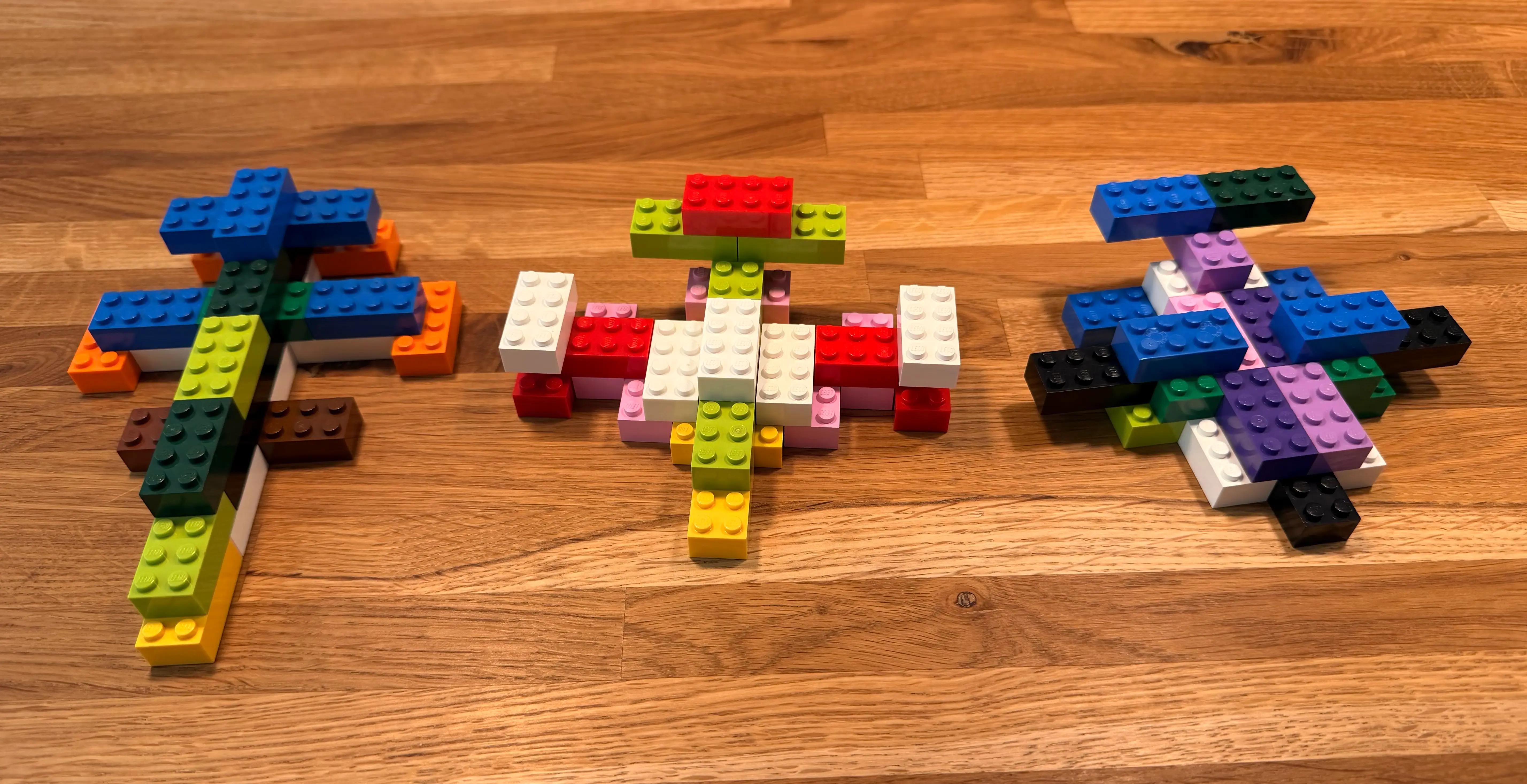
The constraints remove most of the noise. You no longer have to design the perfect starship. You simply have to make something starship-like with what’s in front of you.
In TDW-land, this intentional narrowing of the virtual “building blocks” at our disposal is what I call a Minimum Viable World.
An MVW.
And in this paradigm, less is more.
Not less forever.
Less for now.
Because it is so much easier to add to something already alive in public — bit by bit, week by week — than it is to perfect something in private until it finally deserves oxygen.
That’s the magic trick.
At some point, you look around and realize your World has already existed for a while.
People have visited.
Some have replied.
Some have subscribed.
Some have lingered.
Some have left.
The thing has begun doing what only living systems can do: interact with reality.
And from those interactions, the latticework starts to form. Small parts begin connecting to other small parts. A line on your Home page creates context for your About page. A phrase in your welcome email gives someone language for something they couldn’t quite name. A short essay becomes a waypoint. A reply becomes a signal. A comment becomes a catalyst.
Emergent properties appear.
Not because you designed the perfect system in advance, but because you gave the system enough structure to exist.
Which leads to the obvious question:
What makes up a Minimum Viable World?
There isn’t a single universal answer, because “minimum” depends on what is viable for you.
For some people, the minimum might be one page.
For others, it might be three.
For someone with an existing business, audience, newsletter, or body of work, the minimum may look different from someone starting with a blank domain and a half-formed sense of what they’re trying to say.
When I started building my current World, it began as a single published homepage.
It doesn’t get much more barebones than that.
For a while, that single page was the initial instantiation of my World. Not the whole thing. Not the mature expression. Not even close. But enough to say:
This is the beginning of the place.
A stake in the ground.
A small fire in the forest.
A signal that something was happening here.
But if I were being more pragmatic — especially for someone building from scratch today — I’d probably make the case that three elements form a better viable minimum:
- Home
- About
- Join
That’s the simplest MVW shape I can see.
Not because these are sacred pages.
Not because every World must begin this way.
But because together they answer three essential questions:
Where am I?
That’s Home.
Who is behind this?
That’s About.
How do I come closer?
That’s Join.
Home gives the visitor orientation.
About gives the World a human center.
Join creates the first meaningful threshold.
That threshold matters because the elegant beauty of websites and blogs is also their weakness: they don’t automatically broadcast themselves whenever something new is added.
Unlike platform-native environments, there is no built-in push mechanism. No algorithm deciding who sees what. No feed distribution. No ambient notification layer.
This is part of what makes a website humane — elegantly beautiful even.
But it also means we need to account for it.
A World needs some way for the right person to say:
Yes, I’d like to hear from you again.
This is why email matters so much.
A newsletter is not merely a “marketing channel” bolted onto the side of the World. It is often the first interior space. The first room someone enters after crossing the threshold.
Which means the Join page is not just a signup form.
It is a Gate.
A small but meaningful decision point.
Come closer, or continue exploring.
No pressure. No trapdoors. No timer quietly lying to them from the corner of the screen.
Just a clean invitation.
If the Home page is the trunk — or perhaps the stem of the early sapling — the About page gives that living thing a face, a voice, a backstory. A good About page can do an enormous amount of quiet relational work.
Ben Jackson of Jackson & Co has written the best one I’ve read in recent memory — a reminder that “About” is often less about biography and more about revealing character.
Home can, of course, incorporate who the narrator is. But having a dedicated About page is better in almost every way.
Hey, I’m André…
This is where the human hand behind the World becomes more visible.
Not in a performative “personal brand” sense, but in the older, better sense: character, credibility, texture, taste, lived experience. The small signals that help the right people feel the difference between a website assembled from best-practice blocks and a World shaped by an actual person.
With Home and About, the sapling is planted.
With Join, the first path inward exists.
So perhaps the cleanest framing is a two-phase build.
Phase 1: Plant the World
Build:
- Home
- About
That’s enough to create the first public artifact.
It gives people somewhere to land and some sense of who is speaking.
It does not yet need to be perfect. In fact, it can’t be perfect because the work has not yet had enough contact with reality.
Phase 1 is not about completeness.
It is about existence.
Phase 2: Create the Threshold
Build:
- Join page
- Welcome email
This is where the World becomes more than a static place.
The Join page creates the first Gate of Rome: a clear, pressure-free opportunity for someone to step closer.
But a newsletter signup has implications beyond the page itself.
At minimum, there needs to be one welcome email sent immediately after someone joins.
That welcome email is, in effect, another page inside your email system.
It says:
You made it. You’re in the right place. Here’s what happens next.
It doesn’t need to be elaborate.
It doesn’t need to be a seven-part sequence.
It doesn’t need to solve the entire relationship in one breathless onboarding campaign.
It simply needs to orient.
This, to me, is the practical skeleton of a Minimum Viable World:
- Home
- About
- Join
- Welcome email
That’s enough.
Not enough forever.
Enough to begin.
Because the point of an MVW is not to create the smallest possible website. It’s to create the smallest coherent environment that can start interacting with the people it is meant to serve.
That word matters: coherent.
A single page can be coherent.
A ten-page site can be incoherent.
Minimum is not the same as thin.
Viable is not the same as finished.
A Minimum Viable World is the smallest public expression of your World that gives the right person enough orientation to understand where they are, who is speaking, why it matters, and how to come closer.
Everything else can come later.
Values can come later.
A manifesto can come later.
A codex can come later.
A library of essays can come later.
A community can come later.
A paid offer can come later.
Rome can deepen later.
The early work is not to build the whole city.
The early work is to plant the first settlement.
A road.
A fire.
A signpost.
A place to return to.
And then, as the World begins to exist, you get to become its custodian.
You refine the Home page.
You rewrite the About page.
You improve the Join page.
You replace the clumsy sentence that made sense at 11:47pm but now reads like it was assembled by a raccoon with a thesaurus after eating fermented fruit.
You add the missing context.
You clarify the invitation.
You publish the next artifact.
And slowly, almost imperceptibly, the World becomes more itself.
This is why shipping early is not a compromise of the work.
It is part of the work.
Because until the World exists outside your head, you are not really building a World.
You are rehearsing one.
And rehearsal has its place.
But at some point, the doors have to open.
Even if the paint is still drying.
Especially then.
~André
